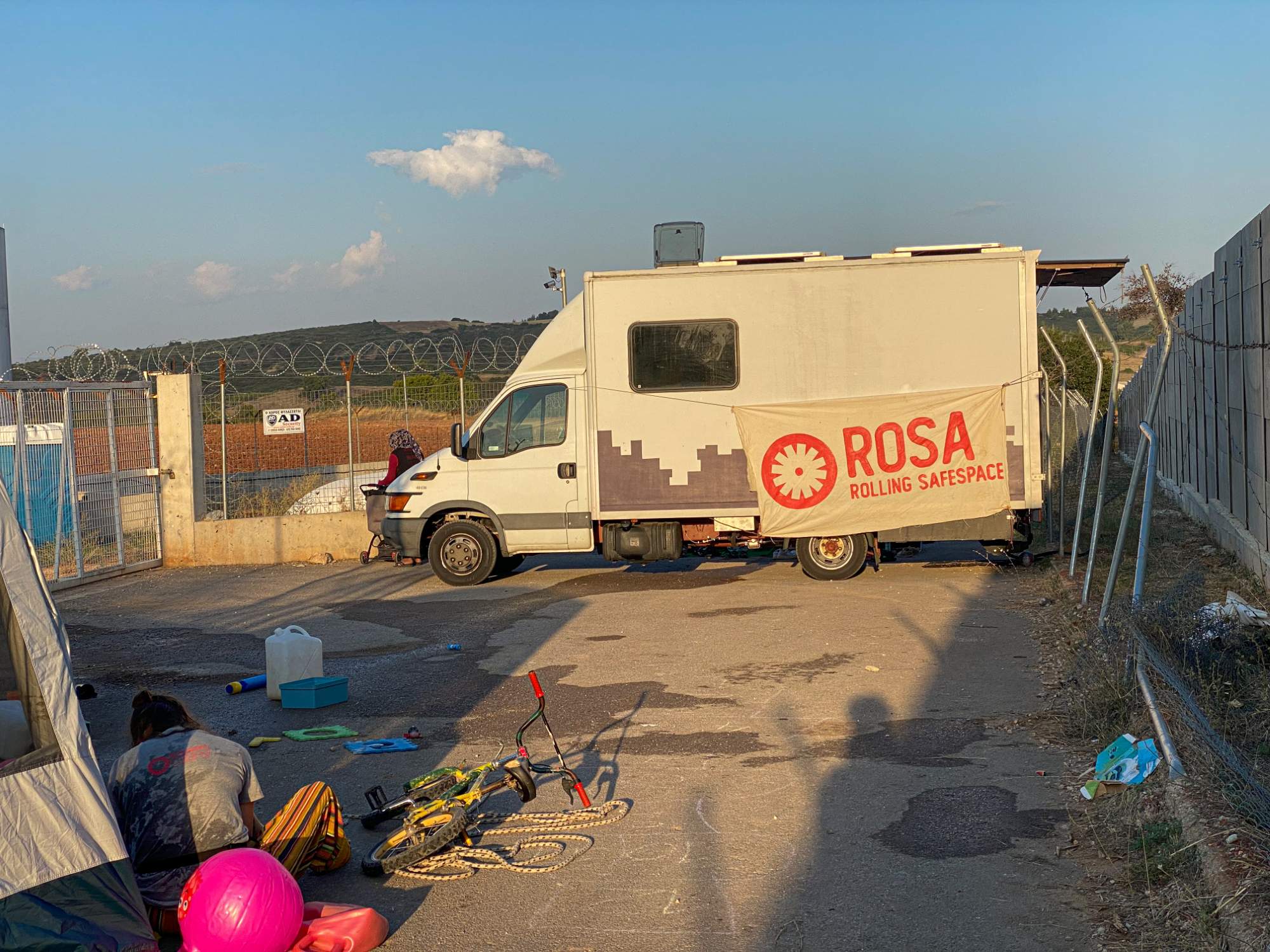
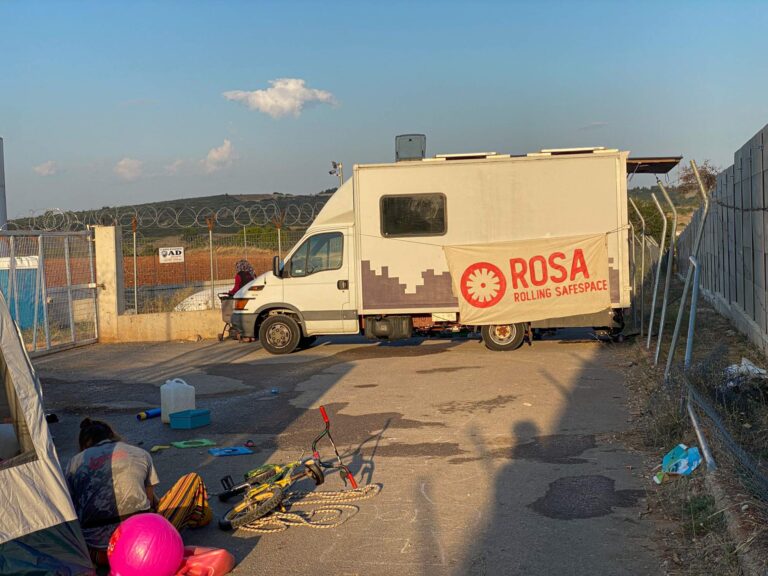
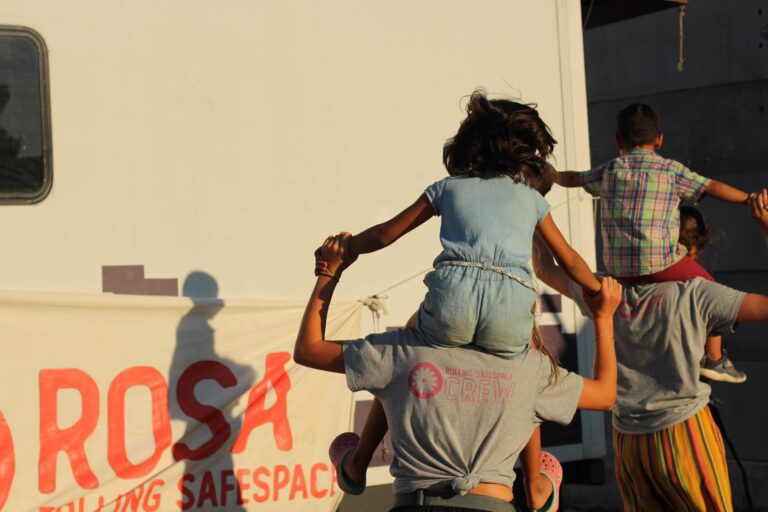
The sun pops onto the small, paved parking lot and the children try to distract themselves from the heat with water games. The women sit in the shade of the tent and drink ice-cold iced tea to survive the hot temperatures.
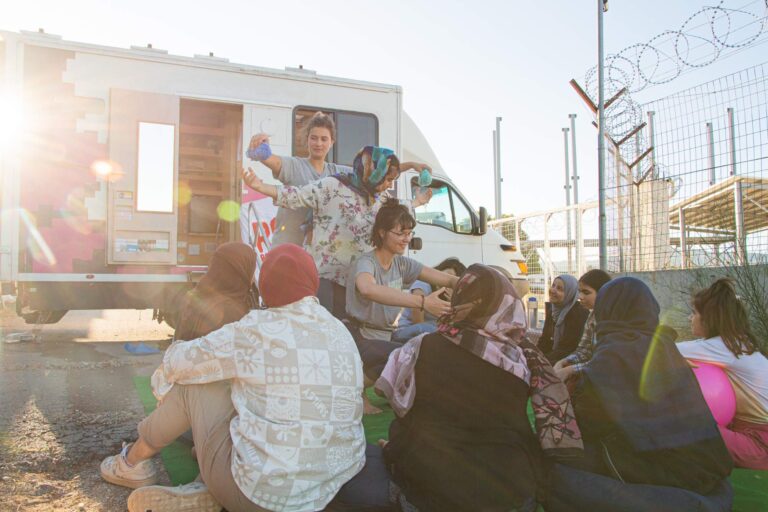
The crew shirts are already completely drenched with sweat and even Café Fredo – traditional Greek iced coffee – only contributes to the cooling. In recent months, it was above all the heat and the missing truck that presented us with new challenges and demanded creative solutions from the crew. With only one car in part, we drove to the camps in Malakasa, Ritsona and Oinofyta and still managed to create a space where the women felt comfortable with a carpet, a few pillows, tea, cookies and tarpaulins for privacy. It didn’t take much to build our “Safe Space”, where we danced together to Afghan and Arabic music and many laughter sounded through the room. The guitars were unpacked, ringcuffs and a woman began to sing, and a small band was formed. Pearled animals were threaded, lanterns and balloons glued, canvases were painted and herbal pillows sewn. Depending on the content, the latter have a sleep-promoting effect, increase concentration or reduce joint pain. Each woman decides for herself what she needs and what is good for her. A “break from hopelessness” – that’s how a woman from Camp named ROSA and the place we want to create together. A place where stories can be shared and where for two hours reality seems far away.
Even the changing weather with rain and thunderstorms does not seem to be an obstacle to the motivation and interest of women. While the crew was still in the car and we thought whether it made sense to set up the tent at all today, the women’s kids already ran to us and literally tore the tent out of our hands, and we had no other choice. From an improvised tent with a tarpaulin attached, women, kids and the crew all rugged together as the wind whistled past us and the rain hit the tent. Stones were painted, crocheted and warm coffee and tea was distributed. Above all, we want to take care to design the space – the Safe Space – together with the women and to leave the space to them, for example with workshops that the women can lead themselves. And indeed: shortly after a woman in Oinofyta told us about her years of experience as a makeup artist, she led the workshop herself and women, crew members and children were painted with different colors and brushes. In Malakasa, on the other hand, pierced: a woman from the camp always has a piercing pistol with her, and various crew members and women enjoyed a new piercing, while the other women romped off in the work with clay and made new chains, bracelets and rings of pearls. There are no limits to creativity here. In addition to the creative workshops, the women can also expand their medical knowledge with the help of our workshops and discussion groups – be it on ovarian cysts, breast cancer screening or menstruation and pregnancy: the focus is on women’s empowerment. Issues such as contraception are also discussed here, and of course there is also room for many open questions and discussions. In doing so, we make sure to convey the topics in a culturally sensitive manner and to address or take into account the different cultures. Among the well-known women, new faces always take advantage of our offer: be it the creative part or rather the medical knowledge.
We currently travel to the 3 camps with an Arabic translator and a Farsi translator, both of whom live in Ritsona. The two are essential for the work of ROSA, not only by doing translation work, but also by communicating culture and are now an integral part of our crew. It was all the more difficult for us to say goodbye to the Arabic translator when she left us at the beginning of September to go to Germany. We organized a farewell dinner together on the beach, and at sunset with the sounds of Arabic music and a string of lights that gave us pleasant warm light, we ate pasta – her favorite dish. In these short moments, which are so full of beauty and joy, one quickly forgets that after our meeting the paths separate again: while we drive home and let the evening end comfortably on the terrace, the 2 translators get off at the camp and have to first go through the turnstile and barbed wire fence to come “home”. In these moments, we are once again aware of the gap between “us” and the refugees.
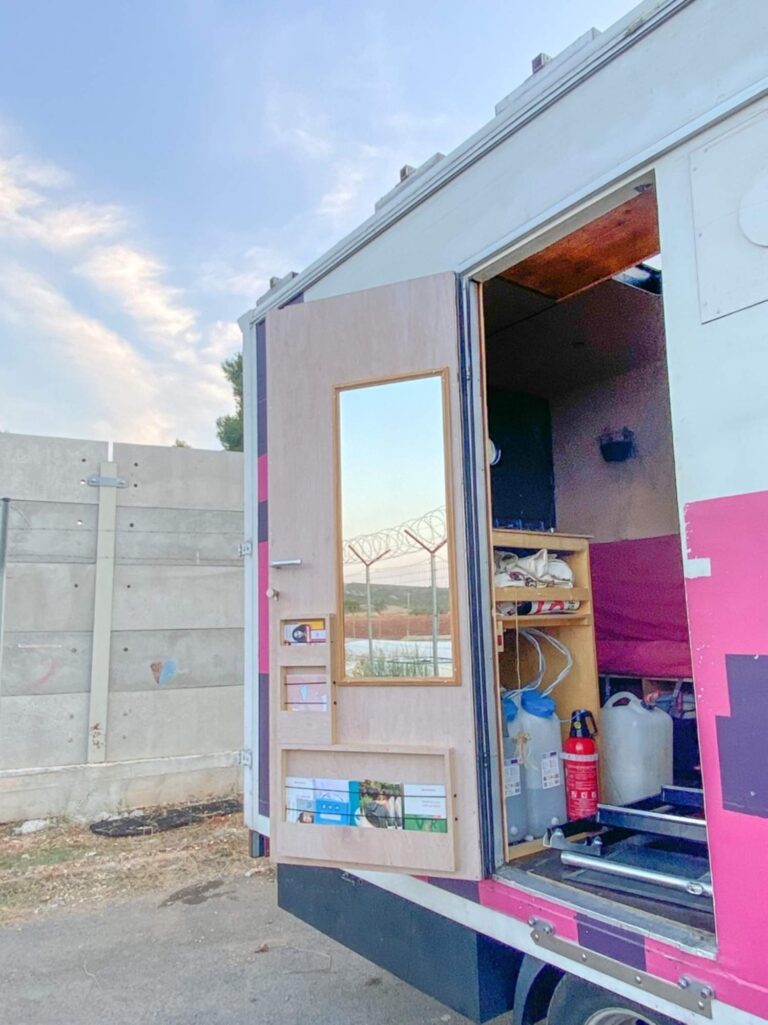
At the end of August, the time had come: the new ROSA Truck finally arrived! Full of joy we spent the first week preparing the truck, conceding it and thinking about a concept of how the truck can be used by the women. We wanted to establish the truck as a safe space for women. A place where they can retire, discuss something personal, or just cook coffee and eat fruit. In addition, the truck provides a safe place for medical consultation with its own lockable room and plenty of equipment, including breast models with palpable tumors to learn self-examination. After numerous preparations, the time had come: now came the Open Truck Day! Full of pride and excitement, we took the women through the truck and showed them where to wash hands, where the garbage is and how to cook coffee. Although the enthusiasm of the women at the beginning was not as great as expected – “yeah, so now you have a new truck; but the old one was bigger …” – it did not take long for the women to independently walk up the stairs and wash their hands or be engrossed in conversations. More and more women are taking the medical consultations and using privacy to talk about personal stories and diseases. A smile flew over our face: that’s exactly what we dreamed of – a safe space for the women! Through the truck, we were also able to pursue our dream of a feminist library in all languages, and this as a low-threshold offer based on flyers in the door frame. Topics such as pregnancy, contraception, termination of pregnancy and the legal situation surrounding sexuality are addressed and dealt with here. And take this home with you! If you want more precise advice, you can of course always contact our media room and take part in a physical examination and a more intensive conversation. The medical offer remains low-threshold, but the contacts to MVI (Medical Volunteers International) and MSF (Medecins sans frontieres/Doctors without Borders) are now well established and in addition to the referral, they also advise us on numerous medical concerns and questions. As a result, we achieve a broad range of medical services and can also arrange people. In addition to these two organizations, however, we are still looking for new contact points that can help us out in general medicine, for example. Since Doctors Without Borders no longer regularly travels to the camps, the placement and medical care is more important than ever. The offer is gratefully accepted and we realize how important and necessary ROSA is for the women – as a place of refuge, as a place they can help shape and as a place where they can exchange and talk.
Share images
-
Activity Report July - September '22
Between heat, camps, and a new truck
-
The sun pops onto the small, paved parking lot and the children try to distract themselves from the heat with water games. The women sit in the shade of the tent and drink ice-cold iced tea to survive the hot temperatures.
-
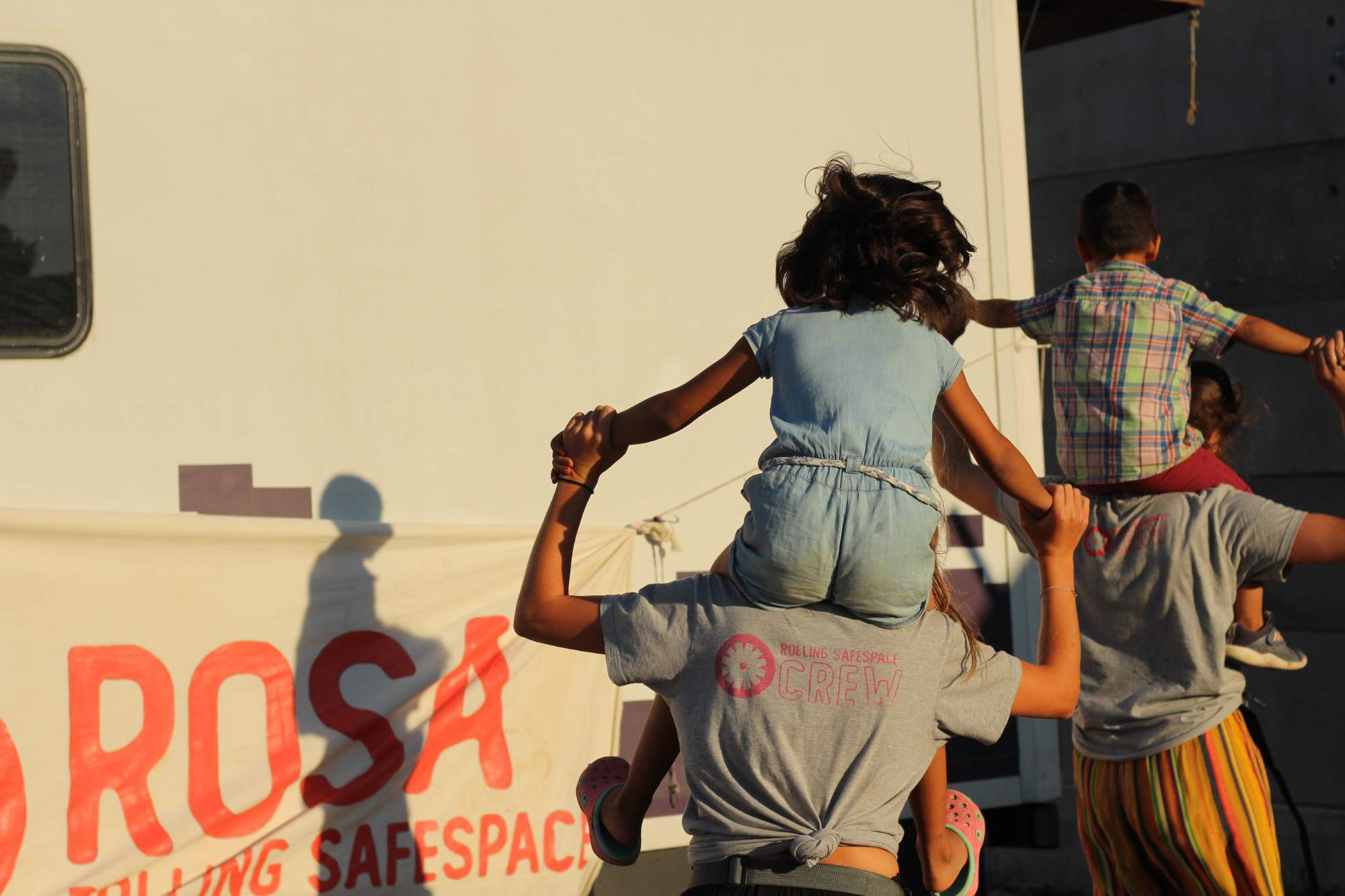
The crew shirts are already completely drenched with sweat and even Café Fredo – traditional Greek iced coffee – only contributes to the cooling. In recent months, it was above all the heat and the missing truck that presented us with new challenges and demanded creative solutions from the crew.
-
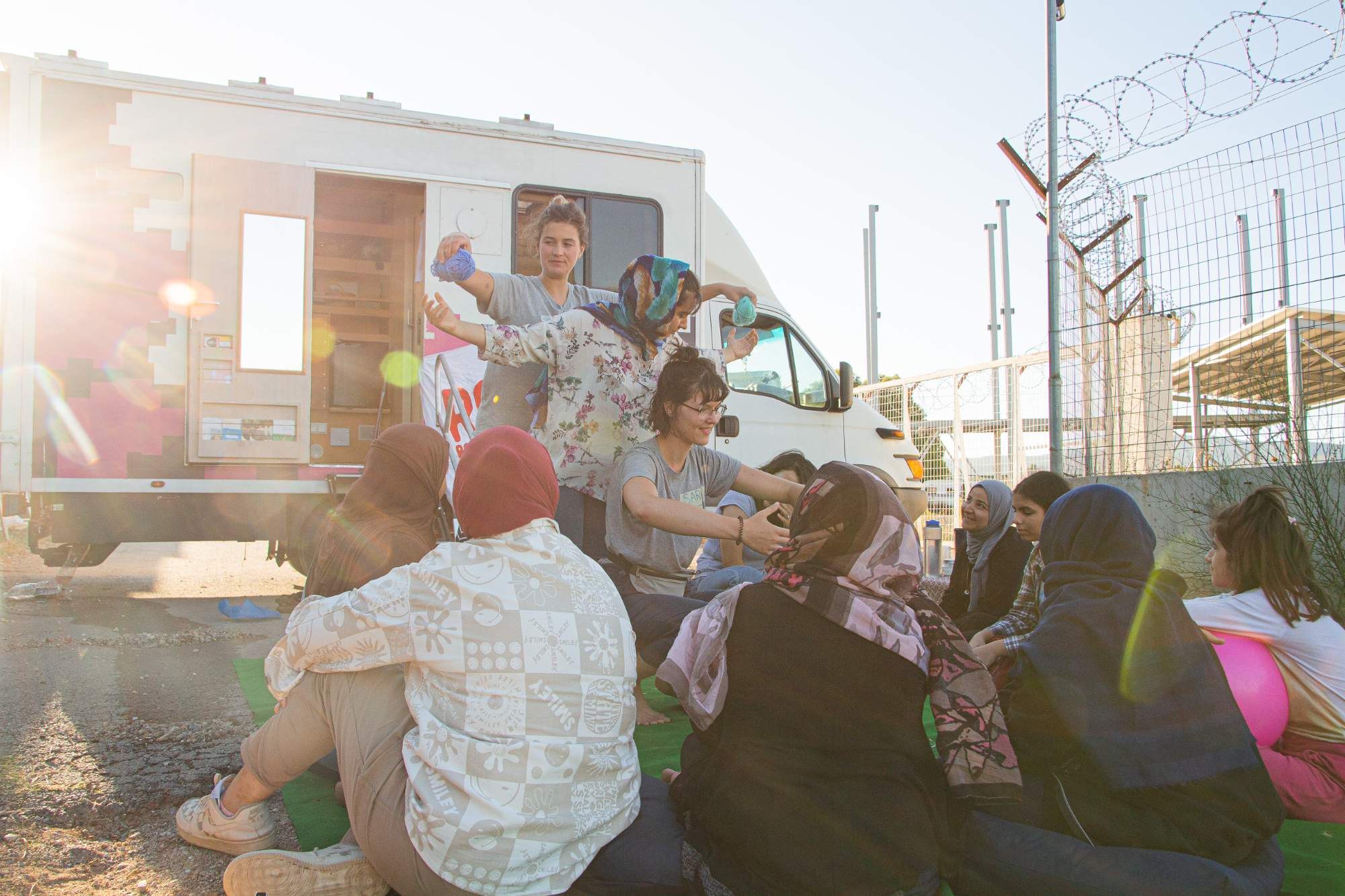
With only one car in part, we drove to the camps in Malakasa, Ritsona and Oinofyta and still managed to create a space where the women felt comfortable with a carpet, a few pillows, tea, cookies and tarpaulins for privacy. It didn’t take much to build our “Safe Space”, where we danced together to Afghan and Arabic music and many laughter sounded through the room.
-
The guitars were unpacked, ringcuffs and a woman began to sing, and a small band was formed. Pearled animals were threaded, lanterns and balloons glued, canvases were painted and herbal pillows sewn. Depending on the content, the latter have a sleep-promoting effect, increase concentration or reduce joint pain.
-
Each woman decides for herself what she needs and what is good for her. A “break from hopelessness” – that’s how a woman from Camp named ROSA and the place we want to create together. A place where stories can be shared and where for two hours reality seems far away.
-
Even the changing weather with rain and thunderstorms does not seem to be an obstacle to the motivation and interest of women. While the crew was still in the car and we thought whether it made sense to set up the tent at all today, the women’s kids already ran to us and literally tore the tent out of our hands, and we had no other choice.
-
From an improvised tent with a tarpaulin attached, women, kids and the crew all rugged together as the wind whistled past us and the rain hit the tent. Stones were painted, crocheted and warm coffee and tea was distributed. Above all, we want to take care to design the space – the Safe Space – together with the women and to leave the space to them, for example with workshops that the women can lead themselves.
-
And indeed: shortly after a woman in Oinofyta told us about her years of experience as a makeup artist, she led the workshop herself and women, crew members and children were painted with different colors and brushes.
-
In Malakasa, on the other hand, pierced: a woman from the camp always has a piercing pistol with her, and various crew members and women enjoyed a new piercing, while the other women romped off in the work with clay and made new chains, bracelets and rings of pearls. There are no limits to creativity here.
-
In addition to the creative workshops, the women can also expand their medical knowledge with the help of our workshops and discussion groups – be it on ovarian cysts, breast cancer screening or menstruation and pregnancy: the focus is on women’s empowerment. Issues such as contraception are also discussed here, and of course there is also room for many open questions and discussions.
-
In doing so, we make sure to convey the topics in a culturally sensitive manner and to address or take into account the different cultures. Among the well-known women, new faces always take advantage of our offer: be it the creative part or rather the medical knowledge.
-
We currently travel to the 3 camps with an Arabic translator and a Farsi translator, both of whom live in Ritsona. The two are essential for the work of ROSA, not only by doing translation work, but also by communicating culture and are now an integral part of our crew. It was all the more difficult for us to say goodbye to the Arabic translator when she left us at the beginning of September to go to Germany.
-
We organized a farewell dinner together on the beach, and at sunset with the sounds of Arabic music and a string of lights that gave us pleasant warm light, we ate pasta – her favorite dish.
-
In these short moments, which are so full of beauty and joy, one quickly forgets that after our meeting the paths separate again: while we drive home and let the evening end comfortably on the terrace, the 2 translators get off at the camp and have to first go through the turnstile and barbed wire fence to come “home”. In these moments, we are once again aware of the gap between “us” and the refugees.
-
At the end of August, the time had come: the new ROSA Truck finally arrived! Full of joy we spent the first week preparing the truck, conceding it and thinking about a concept of how the truck can be used by the women. We wanted to establish the truck as a safe space for women.
-
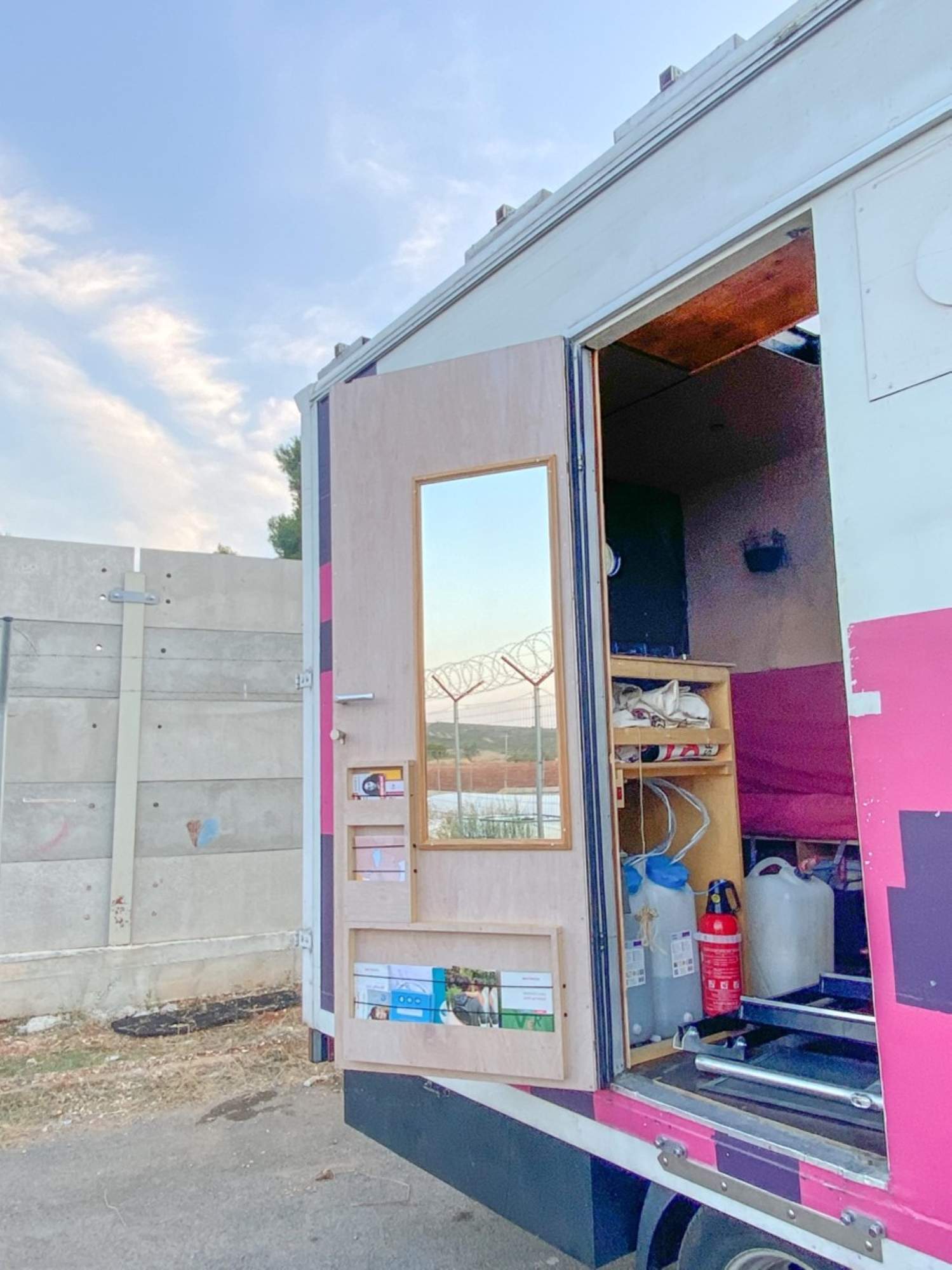
A place where they can retire, discuss something personal, or just cook coffee and eat fruit. In addition, the truck provides a safe place for medical consultation with its own lockable room and plenty of equipment, including breast models with palpable tumors to learn self-examination. After numerous preparations, the time had come: now came the Open Truck Day!
-
Full of pride and excitement, we took the women through the truck and showed them where to wash hands, where the garbage is and how to cook coffee. Although the enthusiasm of the women at the beginning was not as great as expected – “yeah, so now you have a new truck; but the old one was bigger …” – it did not take long for the women to independently walk up the stairs and wash their hands or be engrossed in conversations.
-
More and more women are taking the medical consultations and using privacy to talk about personal stories and diseases. A smile flew over our face: that’s exactly what we dreamed of – a safe space for the women! Through the truck, we were also able to pursue our dream of a feminist library in all languages, and this as a low-threshold offer based on flyers in the door frame.
-
Topics such as pregnancy, contraception, termination of pregnancy and the legal situation surrounding sexuality are addressed and dealt with here. And take this home with you! If you want more precise advice, you can of course always contact our media room and take part in a physical examination and a more intensive conversation.
-
The medical offer remains low-threshold, but the contacts to MVI (Medical Volunteers International) and MSF (Medecins sans frontieres/Doctors without Borders) are now well established and in addition to the referral, they also advise us on numerous medical concerns and questions. As a result, we achieve a broad range of medical services and can also arrange people.
-
In addition to these two organizations, however, we are still looking for new contact points that can help us out in general medicine, for example. Since Doctors Without Borders no longer regularly travels to the camps, the placement and medical care is more important than ever.
-
The offer is gratefully accepted and we realize how important and necessary ROSA is for the women – as a place of refuge, as a place they can help shape and as a place where they can exchange and talk.
Pressebilder zum Download
Die Bilder dürfen ausschließlich im Zusammenhang mit der Berichterstattung über das Thema dieser Pressemitteilung verwendet werden. Bitte die jeweils angegebene Bildquelle nennen.
-
Bildquelle: ROSA e. V.
Original herunterladen -
Bildquelle: ROSA e. V.
Original herunterladen -
Bildquelle: ROSA e. V.
Original herunterladen -
Bildquelle: ROSA e. V.
Original herunterladen