ROSA Knowledge
Here you will find knowledge of flight, racism, support, queerfeminist perspectives and health. Choose a topic area and open the chapters that interest you.
‘Refugee’ as a legal term
ROSA uses the term “refugee” exclusively when it comes to the legal residence status, because it is a term defined under international law.
‘…a person who is outside the country of his or her nationality because of a well-founded fear of persecution because of his or her race, religion, nationality, membership of a particular social group or because of his or her political convictions, and who cannot or does not wish to avail himself or herself of the protection of that country.’
This definition still forms the basis of international protection for refugees, and people fleeing war, poverty or environmental disasters do not automatically fall under this definition, but can receive subsidiary protection or humanitarian residence.
Many forms of gender-based violence, such as rape, forced marriage, genital mutilation (FGM/C), domestic violence, “honour killings” or violence against queer people, are covered by the concept of “belonging to a specific social group”. Gender Guidelines The EU Qualification Directive (2011/95/EU) also requires Member States to take gender-related aspects into account when examining asylum applications.
UNHCR. The 1951 Refugee ConventionUnited Nations High Commissioner for Refugees. The 1951 Refugee Convention | UNHCR US
UNHCR (2002). Guidelines on International Protection No. 1: Gender-Related Persecution within the Context of Article 1A of the 1951 Convention and/or its 1967 Protocol relating to the Status of RefugeesUnited Nations High Commissioner for Refugees. Guidelines on International Protection No. 1: Gender-Related Persecution within the context of Article 1A(2) of the 1951 Convention and/or its 1967 Protocol relating to the Status of Refugees (HCR/GIP/02/01) | UNHCR
Qualification Directive (2011/95/EU). Information on asylum information & Migration. Information on asylum information & Migration – Qualifications Directive (2011/95/EU)
Gender-based persecution as grounds for asylum in Germany
In 2020, around 43,000 women and girls submitted initial asylum applications in Germany, mainly from countries with particularly strong patriarchal structures and a high potential for violence against women and LGBTQI* persons. Gender-based persecution is now considered a legitimate reason to flee, but in practice, people are often given inadequate protection, as many are not sufficiently aware of their rights in the asylum procedure or have difficulty enforcing them.
The legal framework for protection against gender-based persecution in the asylum process is based on national and European laws and international agreements, and in Europe the EU Charter of Fundamental Rights, the European Convention on Human Rights and the EU Qualification Directive include standards for the protection of refugees, including the consideration of gender-based persecution. Those affected by gender-based violence are considered to be particularly vulnerable under the Reception Directive (2013/33/EU).
In 2005, the legal situation in Germany improved due to the entry into force of the Immigration Act, which explicitly recognised gender-based persecution as a reason to flee and made it clear that persecution can also come from non-state actors. The German Asylum Act and the Residence Act thus guarantee protection against persecution based on gender or sexual identity. In addition, the Istanbul Convention (an international treaty for protection against violence against women), which has been in force in Germany since 2018, calls for comprehensive protection measures for women affected by violence.
Germany is legally obliged to make asylum procedures gender-sensitive, in particular for particularly vulnerable groups such as unaccompanied minors or victims of human trafficking, including targeted advice by specialised bodies and the deployment of special representatives who take into account the specific needs of affected persons.
Despite these legal requirements, people affected by gender-based persecution often do not receive residence status in Germany; in 2020, the recognition rate of asylum applications due to gender-based persecution was only 2.2% for female applicants, partly because of the particular challenge of proving gender-based persecution. Biological sex or gender identity is not sufficient grounds for persecution, but individual persecution on grounds of sex must also be proven, and it is a key challenge in the asylum procedure to prove gender-based persecution and to have to present experiences of violence and discrimination independently. Overall, it is also evident that those affected by gender-based violence are often not sufficiently recognised as such in the asylum procedure or encounter structural hurdles that make it considerably more difficult for them to assert their rights and special protection needs.
The Federal Office for Migration and Refugees grants applicants the opportunity to be heard by female employees and offers special representatives for gender-based persecution on request. Those seeking protection due to gender-based persecution can indicate before the hearing which gender or gender identity the person hearing, deciding or interpreting should have in order to feel safer, but it remains up to those concerned to provide the evidence of their persecution themselves, which is a high emotional burden.
An additional difficulty is the ‘domestic escape alternative’, which claims that a safe stay is possible in certain regions of the country of origin, which can lead to the refusal of the right to protection, even though the danger to the person concerned still exists.
In addition, there are structural shortcomings in the asylum procedure, including the lack of identification of persons who may be affected by gender-based persecution and are therefore entitled to consultation with special representatives, and inadequate information on rights and procedures.
All in all, it can be said that people affected by gender-based persecution are not sufficiently identified in the asylum procedure or face obstacles that make it considerably more difficult to assert their needs and rights, and therefore urgent action is needed to better support refugees and queer people who have experienced gender-based persecution in the German asylum system. Refugee law and decision-making practice require a change towards adequate consideration of the diversity of sexual orientation and gender diversity as reasons for flight. In addition to legal adaptation, the responsible authorities must be made more aware and gender equality must be consistently implemented. Gender persecution continues to be insufficiently addressed in the existing patriarchal system, and necessary structural changes remain limited.
The Paritätische Gesamtverband (2022). Gender persecution in the asylum procedure. https://www.der-paritaetische.de/fileadmin/user_upload/Publikationen/doc/geschlechtsspezifische-verfolgung-2022_aufl2.pdf
Qualification Directive (2011/95/EU). Information on asylum information & Migration. Information on asylum information & Migration – Qualifications Directive (2011/95/EU)
Council of Europe. Istanbul Convention: About the Convention. About the Convention – Istanbul Convention Action against violence against women and domestic violence
Why ROSA says ‘people who have fled’
Only when it comes to the legal status under the Geneva Convention on Refugees is the term ‘refugee’ still used because it has a legal meaning there; in all other contexts, a refugee stands for a language of humanity, dignity and solidarity that puts the person at the centre, regardless of his or her residence status.
ROSA uses the term “refugee” instead of “refugee” when it comes to people fleeing across national borders. The ending “-ling” often has a negating or derogatory connotation in German (similar to words such as protégé or newcomer) and can therefore have a distancing or degrading effect.
Moreover, the term “refugee” has often assumed a negative or stigmatizing connotation in public discourse, as it has often been linked to topics such as overwhelmingness or threat in political and media contexts.
The use of the term refugees makes it clear that many people are fleeing without being legally recognised as refugees, yet they have often had similar experiences and had to leave their country of origin in order to protect themselves and their families. These people are often not considered in political and legal language, because only those who fall into one of the five categories of the Convention on Refugees are taken into account, and living conditions are complex and legal scope for interpretation is used politically to limit protection.
ROSA advocates a feminist and solidarity perspective on flight and migration. Feminism fights patriarchy, which hierarchizes people according to external characteristics and disables and disables all those who are not cis-male. White In a feminist world, all human beings are equally valued, have the right to flee wherever they wish and to receive support and protection in emergencies; solidarity means not sorting by legal status, but recognising and upholding the humanity and dignity of each individual.
Racism, neocolonialism, white saviorism and displacement
Colonialism
Colonialism was an epoch that stretched from the end of the 15th century to the first half of the 20th century. 500 years ago, Europeans began to spread through colonization and land-grabbing using violence and exploitation, imagining that they were superior to the indigenous population due to physical and/or cultural characteristics, origin and/or nationality (racism). They justified the created power relations, colonialism, enslavement and exploitation with their racist superiority thinking and their duty as White The colonial powers exploited the raw materials of the colonies as well as the people as a workforce by force, destroying the existing economic and social ways of life. This was demonstrated, for example, by the compulsion to use the language of the colonial powers and the sending of missionaries to Christianize the population, during which time numerous acts of violence took place, such as land grabbing and the extermination of entire population groups, violence, brutality and cruelty were elementary components of European colonialism! The destruction of collective structures and the constant exploitation and privatization of commons led to a prosperity in the West, which was the prerequisite for industrialization, which began a supremacy of Europe.
glokal e.V. (2017): Welcome without paternalism. Help and solidarity in support work.
Houben, Vincent; Rehbein, Boike (2022): The Globalized World. Genesis, Structure and Connections.
Neocolonialism
Neo-colonialism describes the relationship between states after the colonial period; after gaining independence, the former colonies depended on economic support; neo-colonialism stands for a policy of powerful states seeking economic domination in a territory of sovereign states. At its heart is the power of the Global North over international resources through control of markets and money.
Neo-colonialism leads to hierarchical and power relations that are racist, colonial and classically justifiable; raw materials and their extraction and the simplest processing processes by means of cheap labor are acquired from the global South for little money; high-quality and expensive products are produced in the global North using skilled workers and modern technologies. Neo-colonialism is driven by capitalism, globalization and the spread of Western values and ways of thinking, and the former colonial powers have developed into rich industrial nations that no longer conquer other countries to secure their supremacy, but benefit from their economic dependence.
Ziai, Aram (2020): Neocolonialism in the Globalized Economy of the 21st Century – An Overview. Momentum Quarterly 9 (3): 128–140.
Laing, Lorenz Narku (2022): 2 Postcolonialism and Racism Criticism as a Method. In: Lorenz Narku Laing (ed.): Political Racism in the Post-homogeneous Society, Vol. 44. Bielefeld: transcript Verlag (Postcolonial Studies), pp. 13–88.
The Global North’s responsibility for the causes of displacement
In the future, the international community will continue to face countless problems such as natural disasters, famine and environmental disasters, civil wars and global diseases, which will continue to lead to many people leaving their homes and making their way to Europe as refugees. It is questionable whether people from the Global North, who themselves have no experience of refuge, can and should contribute to the support of refugees in countries on the European external border or whether they should focus on reducing these global problems and improving refugee policy.
The Global North has a historical and lasting responsibility for the emergence of the structural causes of displacement; for centuries, European countries used colonies to exploit raw materials and human beings, destroying the growing social and economic structures in the Global South; and the resulting inequality remains the basis for global dependencies. The wealth of the North made possible by the colonial period was based on systematic exploitation and laid the foundations for industrialisation and European supremacy, and the gulf between the global North and the South continues to this day and is reflected, among other things, in the economic dependence of many countries in the global South.
The exploitation of resources by importing cheap raw materials from countries in the global south has been going on since colonial times until today, and without the exploitation of the labour and resources of the global south, the products produced in the global north would be considerably more expensive and could not be sold on the world market with the same high profits. It is therefore still the effects of colonialism that lead to the economic dependence of the global South on the industrial nations.
People living in the Global South therefore already have structurally no equal opportunity to participate in the prosperity of the world. The poor economic situation of their countries of origin leads to poverty, violence and lack of prospects. This promotes civil wars, malnutrition, environmental destruction and (racist) persecution. This situation is not only driving people whose health and lives are currently threatened, but also those who see no prospect of a better life for themselves and their children in their country.
In addition, living conditions are deteriorating due to steady climate warming and increasing environmental disasters in the Global South. While the people and countries of the Global North are the main contributors to the climate crisis due to disproportionate greenhouse gas emissions, the people of the Global South are inversely proportionally affected by the climate crisis, especially because there is not enough money for adaptation measures, and more and more regions of the world are becoming uninhabitable, so that people have to flee from these regions.
Western industrialised nations are also contributing to the causes of flight caused by wars and armed conflicts, with weapons and other war material being mainly supplied by Western industrialised nations, with Germany being the world’s third largest exporter of weapons in 2015. In this way, Western countries benefit from armed conflicts and wars and contribute to making conflicts more violent and longer-lasting and therefore more people are fleeing.
European economic policy and the capitalisation and globalisation of agriculture are increasing the number of people in Africa who do not have access to enough food or can no longer afford the prices for it. This is mainly due to the huge subsidies that are mainly used to support the production of cereals and increasingly also poultry meat in Europe and the United States, and which have led to a sharp decline in domestic products, because regional products, especially from small farmers, can no longer be offered competitively. The term describes the purchase of large areas of farmland by large corporations, which often means that people on the ground lose their jobs or can only continue working under worse conditions.
The lack of prospects in their own country, coupled with the hope of a better life in the global North, often leads to flight, and the destruction of knowledge and belief systems in their own country, caused by colonialism, contributes to the lack of prospects in their own country and to the hope that everything is better in the global North. Moreover, today economic and knowledge systems and ways of life are measured by a Western standard: the Global North is considered a measure of advanced civilization, while societies of the Global South continue to be considered inferior to the Global North.
The global North is responsible for the described neo-colonial and capitalist developments, and flight and migration are the consequences of these structures. Since the countries of the Global North are responsible for many causes of flight and continue to exploit the Global South and maintain existing inequalities, the legitimate distribution of resources is a task that must be taken over by the Global North if it wants to make a credible plea for respect for human rights.
Bliss, Frank (2021): Poverty reduction through development cooperation. Claim – reality – perspectives. Wiesbaden: Springer VS.
Houben, Vincent; Rehbein, Boike (2022): The Globalized World. Genesis, Structure, and Connections. 1st Edition. Constance: UTB.
glokal e.V. (2013): With colonial greetings … Reports and stories of stays abroad viewed critical of racism.
glokal e.V. (2017): Welcome without paternalism. Help and solidarity in support work.
White saviorism
White Saviorism is a term coined by Teju Cole and describes a phenomenon in which White People from Western cultures feel that they have to travel to poorer countries to “save” the people on the ground. This can take place, for example, in the form of development work. The problem here is not the will to help, but that this help often takes place without critical (self-)reflection of power and hierarchical differences, causes of grievances, discrimination structures and colonialism. This often results in the image of the pitiful population, which in turn builds up a balance of power that leads to neo-colonial structures: If the members of Western NGOs see themselves as “helpers” and the refugees as “victims” or “needy help”, power structures are created.
White Europeans have understood themselves as “rescuing helpers” even in the colonial period and often still perceive themselves as such. They had and often still have the neo-colonial conviction that they themselves know how to live and behave “rightly”. European ways of life, action and thinking as well as Western norms and values served as a benchmark without question. They portrayed people in the Global South as underdeveloped.
In the work of NGOs, too, there is often a division into the Western, “developed and educated” people and “othering”, who are classified as “underdeveloped, lazy and uneducated”. The division into “helpers” and “helpers in need” creates a clear over-subordination and increases the self-esteem of the volunteers. They assume that they can assess the needs of people on the run and have the responsibility for helping them, and thus consciously or unconsciously consider themselves to be superior. The very concept of “helping others” is permeated by paternalism and imperialist thinking. Therefore, one’s own intentions at work in poorer countries and at work with people affected by racism must be critically reflected again and again.
Fire & BreadWhite Saviorism – Why well-intentioned is often not helpful: #45 White Saviorism – Why well-intentioned is often not helpful – Fire & Bread
“Structural Racism and White Savior Compley,” December 8, 2021. https://www.amnesty.de/allgemein/termine/struktureller-rassismus-und-white-savior-complex#:~:text=.
White Charity. Blackness and whiteness on donation posters. https://www.whitecharity.de/de/home/
Anderson, Kristina R.; Knee, Eric; Mowatt, Rasul (2021): Leisure and the “White-Savior Indus trial Complex”. Journal of Leisure Research 52 (5): 531–550.
Dittmer, Cordula (2018): Decolonial and Postcolonial Perspectives in Peace and Conflict Research. Locations in an Ambivalent Discourse Space. In: Cordula Dittmer (ed.): Decolonial and Postcolonial Perspectives in Peace and Conflict Research. Baden-Baden: Nomos, pp. 7–24.
Schillinger, Sarah (2017): Volunteering with Refugees in Switzerland: Current Dynamics, Pitfalls and Potentials. In: Swiss Red Cross SRC (ed.): Refugees – arrive – participate. Zurich: Seismo (Health and Integration – Contributions from Theory and Practice, 12), pp. 198–211.
Vulnerability and agency
The concepts Vulnerability (vulnerability) and Agency (Power of action) plays a central role in the public portrayal of refugees, and a narrative has established itself, particularly in the European migration discourse, which primarily constructs women as particularly vulnerable, passive and helpless, whereas refugees are often portrayed as self-determined, capable of acting and sometimes even as potentially dangerous or aggressive. These gender-coded images are not neutral, but are the expression of a (neo-)colonial, racist and sexist discourse that produces hierarchies between “deserving” and “non-deserving” people.
The so-called vulnerability discourse is often based on the assumption of an inherent, that is, innate, vulnerability based, for example, on gender, in which refugee women appear as victims of patriarchal societies, as people without their own power to act, who must be saved. This perspective, however, ignores the fact that vulnerability is not only individual or biological, but is essentially generated by structural and systemic conditions: camps, restrictive asylum systems, pushbacks, lack of medical care or gender-based violence are not natural conditions, but are the result of political decisions and global power relations. Vulnerability thus does not arise primarily “because someone is a woman”, but because people live in patriarchal and racist structures that particularly endanger certain groups.
The vulnerability discourse is particularly problematic when it is accompanied by an implicit loss of agency (power of action). When refugee women are presented exclusively as vulnerable, their resilience, strategic decisions and power of action are lost sight of. However, flight itself is a deeply active, often courageous act, a decision that requires enormous risk, planning and perseverance. Also in the context of violence and disenfranchisement, people develop strategies of survival, self-organization and resistance. Agency in this context does not mean the absence of vulnerability, but the ability to act despite vulnerable conditions. People can be vulnerable and capable of acting at the same time.
The communications of non-governmental organisations also show this tension around the use of the term vulnerability, which can make strategic sense, for example to draw attention to grievances or to mobilise resources, while at the same time there is a risk of reproducing stereotypical images of victims and thus disempowering them. A reflective practice should therefore identify structural causes, distinguish different forms of vulnerability and at the same time make agency visible. This also means taking refugee FLINTA* seriously not only as recipients of help, but as political subjects and experts of their own realities.
All people on the run are in a certain way vulnerable, albeit in different ways and to different degrees, and a feminist presentation should therefore both identify the specific gender risks and make visible the power and resistance of those affected. Only in this way can well-intentioned protective discourses inadvertently contribute to the reproduction of colonial and paternalistic power relations.
Butler, Judith (2016): Rethinking vulnerability and resistanceIn: Butler, Judith / Gambetti, Zeynep / Sabsay, Leticia (ed.): Vulnerability in Resistance. & London: Duke University Press, pp. 12–27.
Freedman, Jane (2019): The Uses and Abuses of “Vulnerability” in EU Asylum and Refugee Protection: Protecting Women or Reducing Autonomy? Papeles del CEIC, 2019(1), pp. 1–15.
Gilodi, Amalia / Albert, Isabelle / Nienaber, Birte (2022): Vulnerability in the Context of Migration: A Critical Overview and a New Conceptual ModelHuman Arenas, pp. 1-21.
Hess, Sabine / Elle, Johanna / Hansel, Valeria (2022): Dangerous Men and Suffering Women? Entanglements and Articulations of Gender in the European Border RegimeIn: Hansel, Valeria / Heyer, Katharina / Schmidt-Sembdner, Miriam / Schwarz, N.V. (ed.): From Moria to Hanau: Brutalization and Resistance, Border Regime. Hamburg: Association A, pp. 360–383.
Turner, Lewis (2021): The Politics of Labeling Refugee Men as “Vulnerable”Social Politics, 28(1), pp. 1–23.
Postcolonialism
Postcolonialism is a distinctive discipline that deals with colonial practice, its foundations, its consequences and its long-term effects, so the term postcolonialism can be understood as a suggestion for a critical discourse on the effects of colonialism. Postcolonial studies not only examine neocolonial ways of thinking and power relations, but also clearly distance themselves from colonialism and combat its effects to this day. The background was the rethinking of traditional Western concepts of power, subjectivity and resistance, and the anti-colonial discourses on ethnicity, culture, language and class in this context.
Post-colonialism criticises the various (subtle) forms of neo-colonial rule that still exist today, and is devoted to the question of how complete decolonisation can succeed and how equality and independence of all people and states can be achieved.
Castro Varela, María do Mar; Dhawan, Nikita (2020): Postcolonial Theory. A Critical Introduction.
Laing, Lorenz Narku (2022): Postcolonialism and Racism Criticism as a Method. In: Lorenz Narku Laing (ed.): Political Racism in the Post-homogeneous Society, Vol. 44. Bielefeld: transcript Verlag (Postcolonial Studies), pp. 13–88.
Mauer, Heike; Leinius, Johanna (2020): Intersectionality and Postcoloniality, Critical Feminist Perspectives on Politics and Power.
Decolonization
Decolonisation describes, on the one hand, the process of liberation from all dependencies of colonial powers against the oppressed population or former colony, and, on the other hand, the term is also used for a decolonisation of thought, i.e. to reveal everyday racism, power and hierarchical disparities and racist structural relations that are partly connected with the colonial period. It is therefore a question of examining the internalised racism and making it visible.
Dittmer, Cordula (2018): Decolonial and Postcolonial Perspectives in Peace and Conflict Research. Locations in an Ambivalent Discourse Space. In: Cordula Dittmer (ed.): Decolonial and Postcolonial Perspectives in Peace and Conflict Research. Baden-Baden: Nomos, pp. 7–24.
Racism
Racism is a form of discrimination: people are devalued, marginalised and disadvantaged because of external characteristics such as skin color, origin, language, name or hair; racism is based on the notion – now scientifically disproven – that there are different “races” of people who are in a certain order or hierarchy. This construction of “races” was invented to suppress certain groups and elevate others, lumping certain character traits and traits into the constructed groups, exaggerating one’s own group and devaluing others, fostering a sense of superiority, creating prejudice and promoting social exclusion.
Racism is deeply rooted in European colonial history and closely linked to the development of pseudo-scientific “race research” during which time people were divided into supposedly natural groups, with Europeans being portrayed as superior and people from the global South being portrayed as “uncivilized.” This ideological distinction served not only to legitimize colonial rule, but also to represent Europe as rational, progressive and civilized.
Over time, the form of racism changed: in new-right theories, cultural racism often replaces “classic” biological racism, claiming that certain groups have a fixed, unchangeable culture, supposedly linked to their ethnic or ethnic origin. Again, these attributions serve to naturalize differences and justify a hierarchy between groups of people.
The process by which people are placed into homogeneous groups on the basis of external characteristics and subsequently devalued socially is called racialisation, which can refer to physical, social, symbolic or imaginary characteristics and changes historically but remains an expression of social power relations. Racist narratives and social structures mutually condition and reinforce each other.
Everyday racism refers to racist expressions, actions or ways of thinking that are often unconscious and casual, but are equally offensive and exclusionary to the people affected, and this subtle form of racism is particularly dangerous because it is often not recognized or taken seriously, especially by people who are not themselves affected.
Brückewind e.V. Online-Beratung: Unit 02 – Racism, Eurocentrism, White Saviourism, Volunteer Tourism. https://brueckenwind.org/ob-fuer-freiwillige/ob_e02/
Book by Alice Hasters (2019): “What white people don’t want to hear about racism but should know”
German Centre for Integration and Migration Research (DeZIM). NaDiRa report 2023: Racism and its symptoms. Report of the National Discrimination and Racism Monitor. 7 Nov. 2023, Berlin.
Berliner Entwicklungspolitikr Ratschlag e.V. (ed.) (2016): Bon voyage! Racism-critical ways in development education and project work.
Sookee. (2022, October 20). VEranTwOrtung — column Sookee. Racism in the left scene. Veto magazine. https://veto-mag.de/sookee-antira/
Structural racism
Racism exists in many forms: open, subtle, individual and structural; a particularly profound form is structural racism, which lies not only in the behaviour of individuals, but is anchored in social institutions, norms, laws and media; for example, racism affects asylum and migration policies, where people are treated differently according to the economic “benefits”. Persons who are not considered “productive” are often denied the right to freedom of movement or protection.
Institutional racism also manifests itself in many areas of everyday life, such as education, the labour or housing market (people with foreign-sounding names receive rejections much more often if they have the same qualification). Another example is so-called racial profiling, i.e. the police control of people solely on the basis of their skin colour or ethnicity, regardless of concrete suspicions. This practice was classified by the Federal Anti-Discrimination Agency as a serious violation of human rights and is nevertheless common practice.
Brückenwind e.V. Online accompaniment: Unit 02 – Racism, Eurocentrism, White Saviourism, Volunteer Tourism. https://brueckenwind.org/ob-fuer-freiwillige/ob_e02/
German Centre for Integration and Migration Research (DeZIM). NaDiRa Report 2023: Racism and its Symptoms. National Discrimination and Racism Monitor Report7 Nov. 2023, Berlin.
“Structural Racism and White Savior Compley,” December 8, 2021. https://www.amnesty.de/allgemein/termine/struktureller-rassismus-und-white-savior-complex#:~:text=.
“What is structural racism?” EgoFM, July 27, 2021. https://www.egofm.de/blog/was-ist-struktureller-rassismus.
Book by Alice Hasters (2019): “What white people don’t want to hear about racism but should know”
glokal (2014): Mangoes and Bullets. Materials for racism- and domination-critical thinking and acting
White privilege and the responsibilities that come with it
White People in the global north often unconsciously benefit from structural racism, for example through easier access to education, work, freedom to travel or social recognition, and these benefits exist regardless of whether one considers oneself racist; no one is automatically free of racist thinking simply because he or she does not openly express himself or herself racist. Racism is a structural phenomenon that has inscribed itself in our thoughts and actions through education, language, media images and institutional processes.
It is therefore important that, in particular: White People become aware of their social position and their privileges, reflect on their own stereotypes and Eurocentric views and actively oppose racist structures, which also means not denying their own racism, but recognising, questioning and deliberately countering it. It is not the task of people with experiences of racism to explain their experiences to others or to “teach” them, but instead people should inform themselves independently, for example through books, podcasts, videos or articles in which those affected share their perspectives.
Racism is not an individual misconduct on the part of individuals, but a profound social power relationship that has developed over centuries and continues to this day, and to effectively counter racism requires knowledge, self-criticism, sensitivity and commitment on both the individual and the social level.
Support for people on the move
By mid 2025, the UNHCR said that around 117.3 million people worldwide had been displaced by force, including people fleeing across borders, internally displaced persons (i.e. those displaced within their home country) and asylum seekers whose asylum applications have not yet been decided, of whom around 42.5 million were displaced outside their country of origin.
UNHCR (United Nations High Commissioner for Refugees). Figures at a glance. https://www.unhcr.org/us/about-unhcr/overview/figures-glance
Humanitarian aid
Humanitarian aid is a form of assistance aimed at alleviating the suffering of people in acute emergencies and meeting their basic needs, usually in crisis and disaster situations, such as natural disasters, wars or epidemics.
Typical forms of humanitarian aid include the provision of food, water, shelter and medical care, as well as assistance in the evacuation of vulnerable persons, acute protection against violence and persecution and the development of emergency infrastructures, and humanitarian aid is provided by government agencies, international organisations such as the United Nations and NGOs such as: The Red Cross and local actors.
Humanitarian emergencies exacerbate existing gender inequalities, as women and queer people in crisis situations are often more affected by poverty, violence, discrimination and limited access to resources, education and health care, thereby increasing their structural dependence while further reducing their ability to live a self-determined lifestyle.
Chen Reis and Tania Bernath, ‘International Humanitarian Aid Today’ in Chen Reis and Tania Bernath (eds), Becoming an International Humanitarian Aid Worker (Elsevier 2017)
Emma Mawdsley, ‘The rising powers as development donors and partners’ in Vandana Desai and Robert Potter (eds), The Companion to Development Studies, Third Edition (3rd ed. Taylor and Francis, Florence 2014)
Humanitarian aid for people who have fled
Humanitarian aid is essential for refugees in crisis situations, as it secures basic needs such as food, shelter and medical care, especially during flight and in the first weeks and months after flight, ensuring that the refugees do not immediately end up in existential distress as a result of the consequences of the flight.
Humanitarian aid therefore also requires shelters for women refugees and queer people, in order to provide them with safety from violence and discrimination, to preserve their dignity and to provide them with access to support tailored to their needs.
Gil Loescher and others (eds), Protracted refugee situations: Political, human rights and security implications (United Nations University Press, Tokyo 2008)
Alexander Betts and others, Refugee economies: Forced displacement and development (First edition Oxford University Press, Oxford 2017)
Problems with humanitarian aid
However, humanitarian aid, if it is offered in an unreflected manner, can also have disadvantages: a central problem of humanitarian aid for refugees is the dependence it can create, but short-term aid can cover acute needs, but it does not promote self-determination or a long-term perspective for refugees. As long as they are dependent on external support and do not have access to basic rights such as work, education, social security or self-determination, they remain socially dependent and isolated, and this dependentness not only complicates a self-determined life, but also leads to the narrative of refugees as “recipients of aid”, which makes their integration in the host countries more difficult. In summary, refugee support is in many cases focused on acute needs without creating sustainable prospects that enable a self-determined independent life.
In addition, the responsibility for providing basic services is increasingly delegated by states to NGOs, which often provide humanitarian aid to refugees but cannot provide sustainable solutions due to their limited capacities; NGOs are important for direct aid, but often lack funds and coordination for structural and long-term support and integration.
Alexander Betts and others, Refugee economies: Forced displacement and development (First edition Oxford University Press, Oxford 2017)
Lack of humanitarian aid in camps in Greece
Humanitarian aid in the refugee shelters in Greece is often inadequate and leaves refugees in precarious living conditions; in the camps around Athens, thousands of people live in cramped space, often with many people in a container, where the heating systems do not work properly or where the mold on the walls leads to extremely poor living conditions. This overcrowding promotes the spread of infectious diseases, exacerbates psychological stress and leads to social tensions and conflicts.
Medical care in the camps in Greece is catastrophic and inadequate, and diseases such as respiratory and gastrointestinal infections, which are spread quickly in the crowded camps, skin lesions, chronic back pain, stress-related hair loss and gynecological problems, such as vaginal infections, are common complaints. In many camps, there are doctors: inside only once a week on site, so that not all patients can be treated.
Another problem is that prescribed medicines are often not available because they have to be paid for themselves and are either too expensive or simply unavailable, and there are reports of a lack of basic medicines such as painkillers, antibiotics or medicines for people with chronic conditions such as diabetes or asthma. The shortage of medicines means that many patients with health problems who need long-term medicines cannot be adequately cared for, as does the transfer to specialists, who often have high transport costs and language barriers.
Despite the efforts of medical NGOs, such as Medical Volunteers International, the situation remains difficult, and their efforts to integrate refugees into the public health system are a major challenge, as transport costs, language barriers and structural racism make access to the Greek health system considerably more difficult. MSF has completely ceased its activities in the refugee camps around Athens and is no longer working on the ground, exacerbating the existing supply deficits, as MSF previously played a central role in medical first aid.
Another major problem is the end of the EU-funded Philos II programme, which expired in the summer of 2024 and was intended to provide primary medical care for refugees. Philos II financed staff in camps and reception facilities, organized vaccinations, basic examinations and integration into the public health system – with the expiration of contracts for doctors, nurses and interpreters, which particularly affects chronic diseases such as diabetes, asthma or heart problems: regular checks and medications are now severely delayed or no longer ensured.
The IOM’s successor programme Hippocrates does not close this gap: it only includes limited teams in selected camps with a focus on acute cases and triage, shorter attendance times and without continuous care for complex diseases. Temporary funds lead to a shortage of staff, sporadic care and lack of coordination to clinics – transport costs, language barriers and discrimination further complicate the remaining access. Overall, health care is deteriorating massively, especially for the chronically ill, pregnant and mentally burdened. NGOs such as Medical Volunteers International (MVI) continue to implement one-off assistance, but encounter limits due to a lack of integration into the public system, transport barriers and racism. The connection of refugees to the public health system also remains an unresolved problem. The high cost of transportation and medication puts an additional burden on many people, leaving them unable to take the necessary treatment, and overcrowding and unhygienic conditions continue to promote infections, with inadequate care for chronic diseases such as asthma; without MSF presence and with persistent staff shortages at EODY, waiting times and drug availability deteriorate.
The basic food and clothing supply is also inadequate, with many camps where the food portions are insufficient to meet the daily calorie needs of refugees, and the meals offered are often monotonous and unnutritious, sometimes even mouldy, leading to a deterioration in nutritional status. In addition, many camps do not distribute winter-friendly clothing, which is particularly challenging in the cold months, and there is also an acute shortage of sanitation: there are often few showers and toilets that are in poor condition and are not regularly cleaned, leading to unhygienic conditions that promote disease and infection.
In many camps, there is no separation between the sexes, which is a major security gap, especially for women, queer people and children.
Development aid and cooperation: changing priorities over time
Development aid aims to promote economic and social development in less developed countries, historically, development aid has been aimed at combating poverty and building infrastructure, often focusing on short-term projects and programmes to improve living conditions.
Over the years, the focus of development aid has shifted from purely infrastructural projects to a more holistic approach that also includes issues such as poverty reduction, human rights and environmental protection. Today, there is an increasing awareness that aid must not be understood as a unilateral act of giving, but that the promotion of self-determination and autonomy of the countries and people affected is a central component of development aid.
UNGA, Declaration on the Right to Development, Resolution (4 December 1986) A/RES/41/128.
UNGA, Transforming our world: the 2030 Agenda for Sustainable Development (21 October 2015) A/RES/70/1.
Richard Black and Ceri Oeppen, ‘Refugees’ in Vandana Desai and Robert Potter (eds), The Companion to Development Studies, Third Edition (3rd ed. Taylor and Francis, Florence 2014)
Development aid for displaced people: problems and challenges
However, in the case of refugees, development aid is often not sufficiently targeted at their specific needs; while most development aid measures are focused on supporting host countries, the direct needs of refugees are often not adequately addressed. Programmes such as the Global Compact on Refugees (GCR) and the Asylum, Migration and Integration Fund (AMIF) focus primarily on strengthening host country capacities and improving refugee systems. By 2027, the AMIF aims to strengthen the European asylum system, integrate legal migrants, combat illegal migration through return and better share responsibility between Member States. While all goals are aimed at the development of European states, only the second benefits the refugees themselves. Host societies receive the necessary support to provide humanitarian aid and to enable refugees to live independently, but this support is only provided at the request of the host country or country of origin and not at the request of the refugees.
During a conversation with BAMF staff in 2022, we were told that ROSA had a chance of receiving funding under the AMIF programme, but for that we would have to adapt our concept a little bit. First of all, we would have to work only with legal refugees, i.e. people who had already filed an asylum application with a fingerprint in Greece. All the other people should not be supported with European money, which is why we have been suggested to carry out a document check at the entrance of the Safer Space, and we have also been advised to create even more workshops on the integration of the people in Greece, preferably through regular Greek lessons. We all agreed that it contradicted the concept of our Safer Space to open it only to legal refugees, and many women had told us that they did not want to apply for asylum in Greece because then it was likely that they would have to stay there because of the Dublin III Regulation. According to the Dublin III Regulation, the country responsible for the asylum procedure is the country in which the refugees were registered in the EU for the first time, which means that many more asylum procedures take place in countries at the external borders of the EU.
Many refugees in Greece would like to go to Northern or Central Europe. A woman at Camp Ritsona said: I am trying to learn Greek and get to know locals. Nevertheless, I see no future for us in this country, especially because of the poor labour market.When reading through the eligibility criteria of the AMIF, it becomes clear that it is particularly important to make it more difficult to flee to Central Europe and to support the integration of refugees in countries on the European external border. Since we do not want to adapt our concept to these funding guidelines, but want to provide a safer space that is oriented to the wishes and needs of the women in the camps, a funding by the BAMF was not considered for us.
European development aid is increasingly invested in border security and return measures, while civil sea rescue is sanctioned and illegal refoulements at land borders are tolerated; increased border security leads to increased violations of human rights and refugee rights; this development aid is aimed at preventing refugees from fleeing to the global north. In addition, refugees often do not have access to essential resources such as education, the labour market and social safety nets, which prevents them from integrating into society in the long term and living a free, self-determined life.
This makes it clear that European development policy in the refugee context often does not focus on protection and participation, but on the regulation and limitation of migration; as long as development aid is primarily used to control migration and is not consistently geared towards the rights and needs of refugees, it helps to stabilise existing inequalities and exclusion mechanisms.
European Migration Fund – Homepage. Website of the Federal Ministry of the Interior and for Homeland. https://www.eu-migrationsfonds.de/DE/Startseite/startseite_node.html
UNHCR – Global Compact on Refugees.
Website of the United Nations High Commissioner for Refugees (UNHCR). https://www.unhcr.org/about-unhcr/overview/global-compact-refugees
Brian-Vincent Ikejiaku, ‘Migration, Poverty, the Role of State, (International) Law and Development in the Industrialised Countries of Europe’ (2021) 14 Law and Development Review 465
Midori Kaga, ‘Re-conceiving refugee situations from a development perspective, Providing durable solutions for refugees through development’ (2019) 31 dia 113
Berlin Development Policy Advice e.V. (ed.) (2013): Develop-mental Turn. Neue Bei lä to a development policy education and project work critical of racism.
The role of NGOs
Non-governmental organisations (NGOs) are civil society actors that act independently of the state and pursue social, ecological or political concerns, acting as a link between the state and society. Although NGOs are often not democratically legitimised, they shape social discourses, demand state responsibility and represent the interests of marginalised groups. Their work requires a democratic basic order in which freedom of association is guaranteed, and NGOs, especially in the global north, are increasingly taking on tasks that were originally incumbent on the state and are particularly capable of acting because of their flexibility, low bureaucracy and global networking.
In international and European human rights agreements, Germany and the rest of Europe have committed themselves to offering protection to politically persecuted people and to those who are in real danger of life, limb or liberty, and people who are fleeing must therefore be given the opportunity to apply for asylum, and they must also be provided with the necessary social services.
However, many Western countries do not or do not sufficiently fulfil this obligation to provide for asylum seekers, so that refugees are dependent on the voluntary support of NGOs. Instead of advancing the development of the necessary state structures, Germany promotes voluntary commitment and thus gives up its responsibility to citizens who engage free of charge.
As a result, NGO work can lead to states no longer being forced to expand or maintain public support for refugees. Moreover, refugees receive the necessary support from NGOs not as social rights holders, but according to the regulations and ideas of the NGOs. The offer of support depends on project durations, funding and political priorities. Refugees are thus forced into the role of supplicants and thus appear as a burden for society.
If people fleeing depend on the private commitment of the people of the Global North and their direct support in refugee camps, this establishes and solidifies a relationship of superiority and subordination between the “helpers” coming from the Global North and the refugees mostly coming from the Global South. As long as support is primarily provided by NGOs, there is a danger that the state’s duty to guarantee social rights will be supplanted and neo-colonial dependency structures will be further consolidated.
As a result, NGOs should address the failure of the state and demand the state takeover of tasks in order to bring about a change in structures, and find their role in the tension between criticism of the state handover of responsibility, demanding the state takeover of tasks and the direct support of refugees in solidarity.
Mutua, Makau (2020): The role of non-governmental organisations in the creation of rights. In: Karina Theurer and Wolfgang Kaleck (ed.): Decolonial Legal Criticism and Legal Practice. Baden Baden: Nomos, pp. 223–262.
Convention Relating to the Status of Refugees (adopted 28 July 1951, entered into force 22 April 1954) 189 UNTS 137 (Refugee Convention).
Tiedemann (2019): Refugee law. the material and procedural foundations. Berlin: Springer.
glokal e.V. (2017): Welcome without paternalism. Help and solidarity in support work.
Schillinger, Sarah (2018): At Eye Level with Refugees? A Postcolonial Look at Pitfalls of Helping. Urban Citizenship, Tour de Lorraine 018: 30–31.
Ziai, Aram (2013): Racism and development cooperation. The Western view of the South from colonialism to today. In: Berliner Entwicklungspolitik Ratschlag e.V. (ed.): Develop-mental Turn. Neue Beiträge zur racismkritiken entwicklungspolitik Bildung- und Projektarbeit, pp. 22–29.
Changes needed in support for displaced people
Humanitarian aid needs to be more closely linked to development-oriented approaches, and refugees should receive extensive human rights-based humanitarian assistance during their flight and immediately after their arrival (access to clothing, food, housing and health care). However, they should not only be seen as recipients of short-term help, but should be treated as active and self-determined actors. Long-term support measures must be more oriented towards the needs of refugees and provide access to work, education, the health system (not just emergency care) and social networks.
Long-term aid should focus on promoting self-determination and networking. Instead of pushing refugees into a passive role as aid recipients, they should be involved in planning and implementing aid projects so that the support offers actually meet the needs of the refugees. The focus must shift from short-term assistance to long-term integration support, which offers refugees the same opportunities for participation and development as the rest of the citizens.
Queerness, feminism and displacement
Patriarchy
The patriarchy (literally): Fatherhood) is a global system of oppression that has historically evolved as a result of the development of sedentaryness, private property and gender division of labor, and it denotes a social order in which cis-men have structurally more power, influence and privilege than women and other genders.
It describes a hierarchical gender order in which men dominate political, economic, religious and family leadership positions, and societal norms, values and laws are overwhelmingly shaped by masculine interests. disadvantaged are all those who deviate from the cis-male, heterosexual ideal – not only women, but also queer, trans, inter and non-binary people.
Patriarchy continues today in all areas of life – in unequal pay, lack of representation in politics and economics, gender-based violence and the devaluation of care work. It relies on traditional role models and heteronormative notions that secure male power and restrict diversity.
At its core, patriarchy is about power and control, shaping our notions of bisexual femininity and masculinity, influencing self-image, desire and social relationships, and heterosexual cis men also suffer from the narrow role models that demand strength, hardship and emotional control, and devalue empathy or vulnerability.
Patriarchy is not a natural system, but a historically developed and not universally equally pronounced power relationship, which has prevailed in many societies – partly in connection with economic and social developments – and can be changed and overcome by feminist and social movements – for a world in which all people can live equally, freely and without fear, regardless of gender, identity or sexual orientation.
Heteronormativity and cisgender people
The term heteronormativity describes and questions the existing norm of bisexuality and heterosexuality and the underlying power relations and privileges. Heterosexual cis persons have advantages over people of other sexual orientations or genders. Those who are not heterosexual and male or female continue to suffer social or institutional exclusion. In the study of heteronormativity, the link between power and domination and gender and sexuality is relevant. One challenge is to consider heteronormativity not only on one level, but in all areas of society – for example in the family, school, politics and media – because it works at different levels of society at the same time.
FLINTA and LGBTQI*
FLINTA
The F in FLINTA stands for woman and refers to all persons who belong (wholly or partially) to the category of woman or are classified by society in this category. The L stands for lesbian or lesbian and stands for a romantic and/or sexual orientation. The I for Inter* refers to persons whose bodies do not conform to the medical norms of branch sexuality, meaning that their chromosomes, gonads, hormone production and/or body shape do not conform to the medical concepts of only “male” or only “female” from birth. T stands for trans*: trans* people do not have the gender assigned to them at birth. A transition is a process by which sexuality itself is determined, for example clothing, make-up, civil status and name changes, oestrogen or testosterone intake and/or gender reassignment operations. Other trans* people do not take these steps. A stands for more agile and refers to people who do not feel that they belong to any gender or can do nothing with the concept of gender.
LGBTQI+ / LGBTQIA*
The acronym LSBTQIA+ stands for lesbian (lesbian), gay (gay), bisexual (bisexual), transgender (transgender), queer, intersex (intersex) and a_sexual (asexual).
Gay represents a romantic and sexual attraction between men, while the B for bisexual describes a romantic and sexual attraction to men and women. The T for transgender represents trans people who do not have the gender assigned to them at birth. For example, clothing, make-up, changes in civil status and name, use of estrogen or testosterone and/or sex-adjustment operations can contribute to this. Other trans* people do not take these steps. Q stands for queer and is now a self-designation of people who do not identify with romantic, sexual and/or gender norms of society. The term queer deliberately eludes a clear assignment and thus breaks down categorizations. A stands for asexual and describes that people have no or little sexual attraction to other people. The “*” at the end shows that the abbreviation is open to all other gender identities and sexual orientations that are not explicitly mentioned in the letters – for example: pansexual, genderfluid, non-binary, demisexual and many other identities.
Overall, at ROSA we have agreed on a gender-appropriate spelling through the gender asterisk to include people regardless of gender in our language.
ROSA’s queer-feminist approach
2In our workshop series “Master against the Patriarchate”, we discussed, among other things, the development of a queers-sensitive basic attitude within our structures. It was discussed whether increased queersensitivity of the crews can contribute to opening ROSA Safer Spaces not only for women, but for FLINTA in the future. Discrimination is complex and is influenced by different facets of identities, such as gender, ethnicity or sexuality, which can overlap and strengthen (intersectionality). Therefore, in order to develop a queerfeminist basic attitude, a critical examination of intersectional power structures is necessary. Thinking about different forms of discrimination is a learning process that is important for a respectful treatment of FLINTA people and their bodies.
With regard to providing a safer space not only for women but also for FLINTA in refugee shelters, the challenge is to ensure that within these spaces there is no discrimination against certain groups, which is important because not all women within a safer space automatically have a queer-feminist attitude. Queer people on the run have often fled discrimination and violence caused by their queer identity, and in a Safer Space for FLINTA, they must be particularly protected from retraumatization and other experiences of discrimination, and the crew on site must therefore be queer-sensitively trained to detect and prevent discriminatory expressions despite difficult working conditions.
Queersensitive means responding individually to each person, asking for their needs and creating an atmosphere of trust. Collectively, you can find out what people need to feel safe during and after border experiences like an escape. The crew should continuously train and learn and exchange with those affected. This also includes a continuous reflection on power relations, as discrimination is complex and influenced by intersectional identities.
A safer space for FLINTA should also address issues such as health, language and work materials, and the health needs of queer people often include hormone treatment and gender reassignment, with discrimination by medical staff and difficulties in reimbursement and insurance often posing challenges. Speech mediation should avoid gendered terms and replace them with more inclusive language to prevent distortions and incorrect translations, and diverse representation in communication materials, as well as customization of forms and delivery of sensitive language are critical to inclusion. Anonymous contact and accessibility must be ensured to support people with different life experiences, including trauma.
Queer people with refugee and migration experiences can enjoy their identities and communities if they receive appropriate support, taking gender and sexual orientations into account and recognizing the person as an expert for themselves. Need-based support requires asking open questions, creating an atmosphere of trust and offering individually tailored support. Important points include the adaptation of language and materials in order to share information inclusively, the creation of a safe space that takes account of individual needs, and regular training and networking are also important to ensure comprehensive support.
In Greece, after much deliberation, we have decided to continue to advertise Safer Spaces for women, based on a protective idea, and we assume that the term FLINTA could lead to critical and non-benevolent issues and, if necessary, bans on participation in the offers and discrimination. We assume that we can better provide Flinta a safe place and support on the flight_Migration if the spaces are advertised for women. If we cannot provide trans, inter or non-binary people in Greece for good reasons, it is our task and our claim on our political stance to be informed (or to inform us) and to connect the people visiting to suitable places of support.
How ROSA uses these terms
For our Safer Spaces in Greece, we have decided in Wording to focus our offer primarily on women and children, as this is an internationally understandable and cross-cultural term and we want to be as clear as possible that our spaces should be shelters. We assume that the term women in our safer spaces in Greece will reach more women and queers than the term FLINTA, because we assume that the word FLINTA could lead to exclusion and discrimination, specifically, for example, by assuming that the word FLINTA is unknown or could be rejected and discriminated against because of patriarchal thinking. Along with this, we see a potential danger of a ban on women and children visiting the space.
Our goal is to open the space to all people affected by patriarchal violence, and we see gender binarities as part of the problem and their overcoming as indispensable, and we are aware that the practical implementation is reaching its limits, which is why it is important for us to be in exchange for refugee queers in order to communicate when needs that we cannot cover are met. Furthermore, it is important to us to set up the Safer Spaces through a FLINTA diverse team to make it easier for Queers to access our Safer Spaces on the run.
Feminism
The term feminism is derived from Feminina (Latin for women) and includes theoretical approaches and social concepts, as well as political movements and attitudes based on them. Feminist analyses define the social order as patriarchal and fight against these patriarchal relations by fighting for women’s self-determination and against their structural disadvantage and oppression.
Since the emergence of feminist ideas in the late 18th century, freedom and equality have been central concerns of feminism. How equality is understood in concrete terms – such as equality, equality, equal opportunities or gender equality – has been answered differently within feminism. This process continues to this day, as feminist goals have not yet been fully achieved despite great achievements.
Wallner, C. (2011) Feminism. In: G. Ehlert, H. Funk, G. Steckling (ed.), Dictionary of Social Work and Gender. Weinheim & Munich: Juventa Verlag. pp. 132-135.
White and Black feminism
In 1851, for the second annual general meeting of the women’s rights movement, the American women’s rights activist, abolitionist and travelling preacher Sojourner Truth came on stage with her now famous speech “Am I not a woman?” White Women* as well as White Men; so sounded from the audience “Don’t let her speak – Don’t let her speak!” At the time Sojourner Truth stepped on stage, the previous speaker – a White Man – transfiguring gender equality as an unattainable utopia by referring to the supposed physical weakness of women*, who, in his view, are unable to do the same hard work as men. Through her biography, Sojourner Truth was able to refute the argument of the previous speaker, because as a woman* she had done work of equal value to the men working alongside her. In her speech, Sojourner Truth addressed the racism and sexism deeply rooted in American society, which affected her personally as a black and as a woman*. “Interaction of different disadvantage dynamics”, which cannot be imagined without today’s feminist discourse, only found a name in 1989 by the lawyer Kimberly Crenshaw: Intersection – intersectionality.
The social imbalance of separation of powers White Women* more dominant and powerful voices than black women*, because, as the literary scholar bell hooks writes, many young black women* still believe that they are only black women. White Women who have driven the feminist struggles in society. This short historical outline is suitable for a critical reflection of one’s own privileges – such as White, not disabled, cis-sexual or middle class – invite. White Feminism is also understood as a critical term to criticize a current of feminism that speaks, acts and thinks from a privileged position, so we understand that it is essential to critically question one’s own perspective.
Bereswill, M. (2011) Intersectionality. In: G. Ehlert, H. Funk, G. Steckling (ed.), Dictionary of Social Work and Gender. Weinheim & Munich: Juventa Verlag. pp. 211-212.
hooks, bell (1982). Black women* and feminism. In: Natasha A. Kelly (ed.), Black feminism. Grundtexte. Münster: UNRAST-Verlag, pp. 62-105.
Kelly, Natasha A. (2019). >Women< In: Natasha A. Kelly (ed.), Black Feminism. Basic texts. Münster: UNRAST-Verlag. pp. 7-14.
Queer feminism
The word queer originated in English and means “strange”, “strange”, deviating from the (heterosexual) norm. In the 1970s and 1980s, in the wake of the act-up movement – during the AIDS crisis – the activists succeeded in redirecting the term queer into a positive evaluation.
Queer is a collective term for all sexual orientations and gender identities that deviate from the heteronormative standard. It is often used as an inclusive self-designation by people in the LGBTQIA* community. Queer describes an open, flexible concept: it refers to people who do not consider themselves exclusively heterosexual or cis-gender (i.e., conforming to the gender assigned at birth). This can include lesbians, gays, bisexuals, trans, inter, non-binary, a_sexual or a_romantic people – as well as anyone else who moves outside of classical gender or relationship norms, but there are no fixed rules about who can call themselves queer; the term thrives on diversity and individual self-definition.
For some, “queer” also stands for some as a critical stance that questions societal norms and power structures, especially those that affect gender and sexuality. Queer aims to break down rigid categories and acknowledge and support a wider variety of identities and expressions.
Thus, a queer-sensitive attitude of all people is crucial because dealing with bodies and respecting desires has an impact on the health, development and interaction with other people. A queer-sensitive attitude counters discrimination and requires empathy, sensitivity and compassion, and the recognition of each person as an expert for themselves.
Queer-feminist theory is a current of feminism that became vocal in the 1990s. A central proponent of this theory is Judith Butler, who describes gender as a social construction of reality and logically advocates a shift from bisexuality to polysexuality. With these theoretical spectacles, equality and difference become null and void and instead seek to dissolve gender in its social and biological meaning, so the queerfeminist theory is directed against heteronormativity and binary gender division.
Wallner, C. (2011) Feminism. In: G. Ehlert, H. Funk, G. Steckling (ed.), Dictionary of Social Work and Gender. Weinheim & Juventa Verlag, pp. 132-135.
do Mar Castro Varela, M. (2011) Queer. In: G. Ehlert, H. Funk, G. Steckling (ed.), Dictionary of Social Work and Gender. Weinheim & Juventa Verlag, pp. 340-341.
Women and queer people on the move
Around 49 per cent of all displaced people are women and girls, many of whom experience additional forms of violence, exploitation or discrimination when they flee.
There are no reliable global statistics for queer people, and this lack of data shows that their realities are often not sufficiently taken into account in international refugee protection. Without data, not only is visibility missing, but also targeted funding and protection measures in order to be able to adequately respond to their specific risks – such as sexual violence, social exclusion or criminal prosecution in countries of origin and host countries.
Sex- and gender-specific causes of displacement
In addition to general causes of displacement, such as war, environmental disasters or political persecution, women and queer people often experience additional reasons to flee based on their gender, gender identity or sexual orientation, and are often affected by violence, discrimination and persecution, and see no other option than to leave their region.
Discrimination and structural inequality in particularly patriarchal societies mean that women and queer people have less access to education, work, money and health care, which makes them more vulnerable to poverty and fewer opportunities to protect themselves from violence and oppression.
In many countries, armed conflicts, political crises and instability significantly increase the risk of gender- and gender-based violence, and women in particular often lose access to resources such as income and education in such situations and become more economically and socially dependent on men. This often leads to an increase in domestic and sexual violence; forced prostitution and forced marriages as supposed “protection” for girls; and rape, which is used specifically as a war strategy.
Furthermore, the destruction of social networks and aid structures as a result of conflicts or political agendas leads to women and queer people in particular losing access to support services, and without these social support structures, such as women’s shelters, their risk of becoming victims of oppression, exploitation and violence increases.
Practices such as female genital mutilation (FGM/C), widow burnings and femicides also force many people to flee to save their lives.
Queer people are also fleeing hostility, prosecution, social exclusion or even death threats because of their sexual orientation or gender identity, and homosexuality is still criminalised in more than 60 countries worldwide, and in some countries the death penalty is even imminent.
Gender- and gender-specific causes of displacement are therefore not a marginal phenomenon, but an expression of deep-rooted social inequalities and patriarchal power structures. In order to ensure effective protection, humanitarian aid must specifically address the specific needs of women and queer people and create safer spaces where they can experience protection, support and self-determination.
In 2020, around 43,000 women and girls submitted initial asylum applications in Germany, mainly from countries with particularly strong patriarchal structures and a high potential for violence against women and LGBTIQ+ persons.
Gender-based persecution is now considered a legitimate reason to flee, but in practice, people are often given inadequate protection, as many are not sufficiently aware of their rights in the asylum procedure or have difficulty enforcing them.
FLINTA* and queer refugees on the run – #solidaritywithoutborders
Gender-based violence
Gender-based violence means any form of violence directed against a person on the basis of his or her gender or gender identity, particularly affecting women, girls, trans*, inter*, non-binary and queer people who do not conform to patriarchal norms or a binary gender understanding. This violence is rooted in unequal power relations between the sexes and serves to maintain patriarchal structures; it can take physical, psychological, sexual, social or economic forms and occurs in all spheres of life – in the private sphere, in public space, in institutions and also in digital space.
The Istanbul Convention of 2011 recognizes gender-based violence as a human rights violation and obliges signatory states to implement comprehensive measures to protect those affected, prevent and prosecute perpetrators. Among other things, it identifies domestic and partner violence, stalking, sexualised violence and harassment, genital mutilation, forced prostitution, human trafficking, forced marriage, forced abortion, forced sterilisation and so-called “violence in the name of honour” as forms of gender-based violence.
Gender-based violence affects people of all ages, social backgrounds and backgrounds, but certain groups are particularly at risk. These include women with disabilities, whose access to protection is often difficult, refugees who are at high risk both in the country of refuge and in the host country, sex workers who often experience stigma and institutional violence, and trans, inter* and non-binary people, who are particularly often the target of hatred and harassment. Furthermore, gender-based violence is a form of violence that is often used as a means of warfare.
Gender and sexual violence constitute a serious violation of human rights, particularly affecting women, children and LGBTIQ+ persons, and is a key obstacle to equality, freedom and self-determination. Combating them requires the consistent dismantling of social power inequalities and the creation of conditions that enable all people to live free from violence, discrimination and fear.
Forms of violence against women and girls – UN Women Germany
Femicide
Femicide refers to the killing of a woman or a girl based on her gender, which makes it clear that this form of violence is not an isolated incident, but an expression of structural and patriarchal power relations, and femicides are often committed in the context of domestic or partner violence, characterised by control, ownership, threats and power inequality.
The term highlights the link between gender-based violence and the killing of women and criticises social and institutional structures that encourage or insufficiently sanction such acts, and therefore femicide not only refers to the act of killing itself, but also to the cultural, social and legal conditions that enable and trivialise violence against women.
In Germany, a woman or a girl experiences domestic violence every three minutes, and in 2023, 360 women became victims of a femicide – mostly by (former) partners who did not want to give up their power and control.
Thus, femicides are not only individual crimes, but a social problem deeply rooted in patriarchal structures, gender inequality and a lack of prosecution, and their naming is a political act that makes the invisible visible and highlights the need for comprehensive protection, education and prevention measures.
Forms of violence against women and girls – UN Women Germany
Feminicide
Feminicide goes beyond individual femicide and refers to the structural context of such acts, describing not only the killing of women, but also the systematic failure of state and society to prevent or adequately punish such crimes, and draws attention to institutional impunity, lack of safeguards and deep-rooted gender discrimination.
Challenges faced by women and queer people during displacement
Women, lesbians, inter-, non-binary, trans and agender people (FLINTA) are often subjected to multiple burdens that make their situation particularly precarious, and in addition to the general burden of the flight experience itself, they also experience discrimination, sexism, violence and a lack of shelters and gender support.
Many refugee shelters have people living in difficult conditions, with camps usually set up in temporary facilities, often surrounded by fences and secured by guarded entrances, and increasing restrictions on access for NGOs, while many people have to spend months or even years in these shelters. Living conditions are characterised by dependency, insecurity and lack of prospects – the state of emergency becomes everyday life. The residents lose a large part of their freedom of action, the camps are isolated from society, and waiting for asylum procedures or help determines life.
The closure of the camps leaves the realities of life of FLINTA people largely invisible to the public, lacking data, attention and protection measures to meet their specific needs, and many camps do not provide safe spaces, so that fighting, drug abuse and sexual assault are common. Poor hygiene conditions, lack of medical care and lack of privacy further exacerbate the situation, Amnesty International reported that female read refugees often describe the camps as “inhumane”.
Particularly serious is the high risk of sexualized and physical violence, and in patriarchally structured camps with unstable social conditions, female readers are particularly at risk. Cramped living conditions and the lack of shelters mean that many people cannot move freely for fear. Often women pose as wives or relatives of other men in order to protect themselves better. According to reports, in Greek camps alone, around 30 percent of all gender-based experiences of violence took place after arrival in 2018, many cases not reported for fear of stigmatization or police assault, while authorities and camp management often ignore the issue.
Another serious problem is the danger posed by sanitation: many camps do not have sufficient sanitation facilities, and their alignment creates specific vulnerabilities, for example, by collecting showers that are accessible to all sexes, sexualized and physical violence occurs more quickly, and in addition, they are usually located far away from the living areas. Women report being watched showering or not daring to use the toilet at night, some use bottles or diapers to avoid assault, and the lack of menstrual products and safe places to change them also affects the health and dignity of those affected. Trans women* experience discrimination when denied access to women’s toilets. For visible trans*, inter* or non-binary persons, a gender segregation of sanitary facilities into “man” and “woman” can make showering life-threatening.
FLINTA people also bear a disproportionate burden in the area of care work: around half of women flee with children and continue to assume the main responsibility for care and reproductive work, which means more responsibility, greater financial burden and less flexibility. Resources allocated to families are linked to the concept of ‘father, mother, child’. This excludes single mothers with children, Gef accompanied by sick and/or elderly relatives and queer families from these resources. Queers may find it a necessary survival strategy to flee unouted. For example, a lesbian woman and a gay man may flee together as a supposed couple. The procedures often fail because the identity of queer people is presented as implausible. Outing in front of authorities can also expose queers to violence and discrimination by officials and security personnel or be (re)traumatizing.
Due to the enormous overload on the camps, the water and food supply in the camps is often catastrophic, water outlets are often located on the margins of the camps, and women and queers are forced to leave potential shelters they have built up, and there is a great risk of, for example, queer-hostile and sexual violence along the way. Food is often scarce, expired or of poor quality, causing health problems, and mothers are usually given baby food only until the sixth month of their children’s life, which puts them under additional financial strain, and women, girls and queers get even less water and food.
Also, medical care is not enough in most camps. There is a high, unmet need for medical care. Infections and parasitic diseases spread quickly due to the miserable sanitation facilities. Chronic and acute diseases, such as vaginal complaints, are sometimes not treated for months to years. Pregnancy and follow-up care are often completely lacking. Pregnancy and breastfeeding present additional challenges, as well as a lack of hygiene products and female doctors and interpreters, which creates significant barriers for many FLINTA. Contraceptives or hormones for trans peopleFor trans people who are or want to undergo hormone therapy, this can mean that they suffer more from sex dysphoria, which can be life-threatening. Mental illnesses increase with the duration of the stay, but are hardly treated.
All in all, FLINTA’s situation on the run is characterised by structural patriarchal power relations, lack of resources, self-determination and protected spaces. FLINTA are not inherently vulnerable because of their gender, gender or sexual orientation – they are made so by the conditions of the run and the camps. A feminist and solidarity perspective on refugees therefore means making these structural inequalities visible, combating them in a targeted manner and creating safe spaces in which all people can experience protection, dignity and self-determination.
Women and queer people are structurally disadvantaged, oppressed and at risk of gender-based violence throughout the world, and for many of those affected, the flight from gender-based violence is the only way out, and they remain at risk of becoming victims of violence and discrimination, even when they are fleeing and in the host countries, because of their disadvantageous position in patriarchal social structures.
Flinta, for example, are at increased risk of becoming victims of physical and sexual violence when fleeing the country, which can be linked to the increase in the willingness to use violence in unstable social and social structures, with huge consequences for those affected, and the survival of gender-based violence can lead to long-term psychological consequences, such as post-traumatic stress disorder.
https://blindspots.support/flinta-und-queere-schutzsuchende-auf-der-flucht/
Safer Spaces
In violent structures, there have always been people who have created safe spaces for themselves. Instigated by queer and black activists and queer and black activism, these are called safe space or safer space. A space/space is always shaped by the actions of people and their relationships with each other. Safer spaces are spaces of care and lived solidarity. Here, retreat, protection and community exchange are created, one goal can be to make experiences visible not as individual but as shared experiences, from which individual and collective self-empowerment and ability to act, everyday life management and political organization can arise, Safer Spaces can thus be places of political and structural change.
Safer Space instead of Safe Space emphasizes that the space can be safer, but not completely safe. Even in a Safer Space, there can be disadvantages. For example, in a Safer Space, which is advertised for all women, the experiences of trans* women and black women are neglected.
Safer spaces are always different and change depending on how people are actively designing the space, safer spaces should be designed by all participants, people create the space to protect themselves from violence and discrimination, and privileged groups are excluded. Although Safer Spaces highlight differences, they can also be a negotiation place for (new) social norms.
At ROSA, we are aware that there can be disadvantages in our safe spaces, too, but we have chosen the wording safe space instead of safer spaces, because safe space is the utopia to be achieved: a place where everyone can feel safe.
Safer Spaces at ROSA
In Greece and Germany, ROSA provides Safer Spaces that address the circumstances and stresses of women on the move and provide a protected space for empowerment. In Greece, Safer Spaces is currently providing accommodation for refugees in Ritsona, Malakasa and Thiva, located north of Athens on the Greek mainland, each with between 500 and 2500 inhabitants.
The pillars of our Safer Spaces can be divided into short-term and long-term goals. Short-term goals can be defined as the following: Mobility; for Rosa, being mobile is an important component in order to reach as many people as possible and to remain as adaptable as possible. Another short-term goal is to offer medical help to people on the run. Rosa offers preventive care, advice and referral to medical specialists in the safer spaces. Furthermore, discussion groups are a pillar of the Safer Spaces, which can serve to exchange experiences. This opens up a space for individual exchange, with the aim of making individual experiences visible as shared experiences and thus supporting individual and collective self-empowerment and ability to act. Furthermore, Rosa is keen to offer sports and workshops to create an environment for empowerment and stress reduction, which in the long term provide tools for the prevention of mental and physical illness. Empowerment can contribute to the acquisition of power of action and lead to a better commitment to one’s own needs and to fight against discrimination. Empowerment presupposes that experiences of incapacity and oppression are processed. For this, there must be safer spaces. It is our concern to involve refugees in project planning and implementation and to create a space for exchange and coming together of refugees and locals. With a focus on feminist solidarity, exchange and networking on an equal footing. Childcare is superficially in the light of giving women with children the opportunity to participate in offers. If necessary, we can dispense sanitary items such as diapers, menstrual items or condoms. So the long-term goals of Rosa are defined by the direct support of refugees. It is our goal to create safer spaces for women and queer people at accommodations for refugees worldwide. Through long-term networking and cooperation with refugees, it is our goal to work together for an inclusive, non-discriminatory, feminist and gender-equitable society. In a long-term perspective, we see the goals of our political work in the fight against the causes of flight, such as human rights violations, (gender-specific) violence and climate change, the abolition of borders and the introduction of a passport of independent freedom of movement, as well as the abolition of gender inequality and patriarchy!
Healthcare and displacement
Healthcare in camps in Greece
Medical care in the camps in Greece is still catastrophic and inadequate, with diseases such as respiratory and gastrointestinal infections, which are spread quickly in the crowded camps, skin lesions, chronic back pain, stress-related hair loss and gynecological problems, such as vaginal infections, being particularly common complaints.
In many camps, doctors are only on site once a week, so not all patients can be treated, resulting in long queues and a delay in the necessary medical care.
Another problem is that prescribed medicines are often not available because they have to be paid for themselves and are either too expensive or simply unavailable, and there are reports of a lack of basic medicines such as painkillers, antibiotics or medicines for people with chronic conditions such as diabetes or asthma. The lack of medicines means that many patients with health problems requiring long-term medication cannot be adequately cared for, including referrals to specialists, who often have high transport costs and language barriers.
Despite the efforts of medical NGOs, such as Doctors Without Borders and Medical Volunteers International, the situation remains difficult. Their efforts to integrate refugees into the public health system are a major challenge, as transport costs, language barriers and structural racism make access to the Greek health system considerably more difficult.
Precarious living situation leads to health hazards: non-functioning heating, mold on the walls, overcrowding promotes the spread of infectious diseases, exacerbates psychological stress and leads to social tensions and conflicts
Doctors Without Borders Withdraw More and More from the Camps Around Athens Due to Lack of Funding and Authorization
The connection of refugees to the public health system also remains an unresolved problem, with the high costs of transport and medicines putting an additional burden on many people and preventing them from receiving the necessary treatment.
The basic food and clothing supply is also inadequate, with many camps where the food portions are insufficient to meet the daily calorie needs of refugees, and the meals offered are often monotonous and unnutritious, sometimes even mouldy, leading to a deterioration in nutritional status. In addition, many camps do not distribute winter-friendly clothing, which is particularly challenging in the cold months, and there is also an acute shortage of sanitation: there are often few showers and toilets that are in poor condition and are not regularly cleaned, leading to unhygienic conditions that promote disease and infection.
Another serious problem is the lack of or insufficiently secured sanitary facilities: the showers and toilets are not only often crowded, but also unhygienic, because cleaning is not done regularly enough and there is a lack of private and safe use, and in many camps there is no separation between the sexes, which is a major safety gap, especially for women, queer people and children.
Healthcare for displaced people in Germany
Currently (as of 05/2026) the health care of asylum seekers is regulated by §§ 4 and 6 Asylum Seekers Benefit Act (AsylbLG). Asylum seekers in Germany receive only limited medical care up to 36 months after arrival in Germany.(Since February 2024 the period of 18 months has been extended to 36 months by the “Repatriation Improvement Act”).
The right to health: constitutional and international legal foundations
In accordance with constitutional law, the state undertakes in the Basic Law to guarantee a humane subsistence minimum and to cover a health subsistence minimum.
Article 25 is the subject of international law. Everyone has the right to a standard of living which guarantees his or her family health and well-being, including food, clothing, housing, medical care and necessary social benefits, as well as the right to necessary social benefits, as well as the right to security in the event of unemployment, illness, disability or widowership, in old age and in other cases of loss of his or her means of subsistence due to no fault of his or her own. Mothers and children are entitled to special care and support. ‘All children, both marital and extramarital, enjoy the same social protection.’ of the Universal Declaration of Human Rights Health.
The International Covenant on Economic, Social and Cultural Rights of 19 December 1966 is legally binding.Article 12: (1) States Parties recognise the right of everyone to the highest degree of physical and mental health attainable by them. The steps to be taken by States Parties for the full realisation of this right shall include the necessary measures: (a) to reduce stillbirth and child mortality rates and to promote the healthy development of the child; (b) to improve all aspects of environmental and occupational hygiene; (c) to prevent, treat and combat epidemic, endemic, occupational and other diseases; (d) to create the conditions for everyone to enjoy medical facilities and medical care in the event of illness.
Access to healthcare for displaced people
In May 2026, the health care of asylum seekers is regulated by §§ 4 and 6 Asylum seekers Benefit Act (AsylbLG). Asylum seekers in Germany receive only limited medical care up to 36 months after their arrival in Germany. In February 2024, the period of 18 months was extended to 36 months by the “Repatriation Improvement Act”.
The Asylum Act applies to people who have applied for asylum, who are obliged to leave the country enforceable, i.e. those affected can be deported at any time (in practice often detention in detention) or people who have a toleration. A toleration is not a residence permit, but is the temporary suspension of deportation, since this cannot be carried out for various reasons (e.g. health reasons). Also entitled to benefits are people who in principle receive benefits according to the AsylbLG for the first 36 months of their stay on the federal territory.The following section refers to the access to the health system of non-illegalized people affected by the AsylbLG.
To sum up, there is a 36-month waiting period with a limited level of performance, in which, for example, no treatment of chronic diseases is guaranteed, and the compatibility of this unequal treatment with the binding pact on economic, social and cultural rights mentioned above is questionable.
A major improvement here could be the electronic health card for asylum seekers by simplified or more comprehensive access to the health system, which removes barriers, avoids unnecessary delays in medically necessary treatment and reduces discrimination and stigmatisation of people who have access to health care through the Asylum Act. The health card for asylum seekers also facilitates uniform billing processes for service providers and abolishes unnecessary parallel structures in social authorities.
Currently, the electronic health card for refugees (eGK) has been introduced nationwide in six countries (Berlin, Brandenburg, Bremen, Hamburg, Thuringia, Schleswig-Holstein), as well as individually in three other countries in individual municipalities and/or districts. The billing will then be made through the health insurance funds, which will then be in contact with municipalities and states, who will then reimburse the health insurance funds for the treatment and administrative costs.
In the other federal states, treatment certificates still exist. These must usually be applied for before each doctor visit to the competent authority. Specifically, this includes being issued with a treatment certificate every three months (valid for only three months) by the case officer at the social security office or the first reception centre. The second option is to collect the treatment certificate before the individual visits to the practice. The third version is that the doctors who assign the treatment appointment request a treatment certificate from the district council office, where doctors check whether the treatment goes beyond the acute primary care.
Since the agency determines the specific scope of action, it can specify specific practices and specific performance restrictions: prescribed medicines must be picked up in the pharmacy; in the case of physiotherapy, certain aids and hospital stays, the social welfare office must approve them in advance; this means that only in an emergency, no prior approval from the social welfare office is necessary. This system discriminates against, stigmatises and endangers the health care of asylum seekers in the long term, and the current model still leads to inequality.
According to the AsylbLG, illegalised people are entitled to basic basic care, but in fact the use of health care is usually not feasible, since the benefits and also for asylum seekers must first be applied for by the social welfare office, which then leads to a transfer of data, since the social welfare office is subject to the obligation to transmit, this leads to the knowledge of the foreigners’ authority about the illegalisation. So is not anonymous and therefore cannot be used.
In medical emergencies, illegalized people are ideally treated directly and remain anonymous, anonymity can be maintained, and the hospital contacts the social security office and the latter is subject to extended security, so this data must not be passed on to the foreigners authority. Among other things, because there are problems in taking over high treatment costs and their requirements, but treatment must not only be guaranteed in an emergency, but there should be comprehensive, full access to the health system for everyone!
There is an attempt to do this with projects around the anonymous treatment certificate, which allows access to the healthcare system and is partly still being implemented and applied as a pilot project in clearing houses.
DIW Berlin, Louise Biddle (2026) https://www.diw.de/de/diw_01.c.897141.de/publikationen/wochenberichte/2024_12_4/verlaengerte_leistungseinschraenkungen_fuer_gefluechtete__ne___uer_gesundheit_____erhoffte_einsparungen_duerften_ausbleiben.html Called on 06.05.2026
Media Service Integration (2026) https://mediendienst-integration.de/bevoelkerung/illegalisierte-in-deutschland/gesundheitsversorgung-von-menschen-in-der-illegalitaet/ Called on 06.05.2026
Anonymous treatment orders and clearing houses (2026) https://anonymer-behandlungsschein.de/ Called on 06.05.2026
Additional information:
The right to health: constitutional and international legal foundations
Under constitutional law, the State undertakes to guarantee a dignified subsistence level and to cover a health subsistence level, which is addressed in Article 25 of the Universal Declaration of Human Rights, but it should be noted that this is not legally binding because there is no central enforcement power and depends on the recognition of the States. However, the International Covenant on Economic, Social and Cultural Rights of 19 December 1966 regulates health care for asylum seekers by §§ 4 and 6 of the Asylum Seekers Benefits Act (AsylbLG). §4 covers sickness, pregnancy and childbirth benefits. To treat acute diseases and pain the necessary medical and dental treatment […] shall be provided. Preventive vaccination […] and The medically required Preventive examinations A dental prosthesis is provided only insofar as this is irreplaceable in individual cases for medical reasons. (2) Mothers-to-be and mothers-to-be medical and nursing assistance and care, midwife assistance, medicines, dressings and remedies shall be provided.
Furthermore, §6 includes other benefits. This includes the provision of benefits in particular if they are used in individual cases to secure the subsistence or Essential for health These include, for example, clothing allowances, maternity clothing, medical expenses allowance and a reimbursement of household goods in the event of a private dwelling. Article 2 of §6 covers the provision of the necessary medical care or other assistance to persons with special needs. This includes, for example, unaccompanied minors or persons who have suffered torture, rape or other serious forms of psychological, physical or sexual violence.
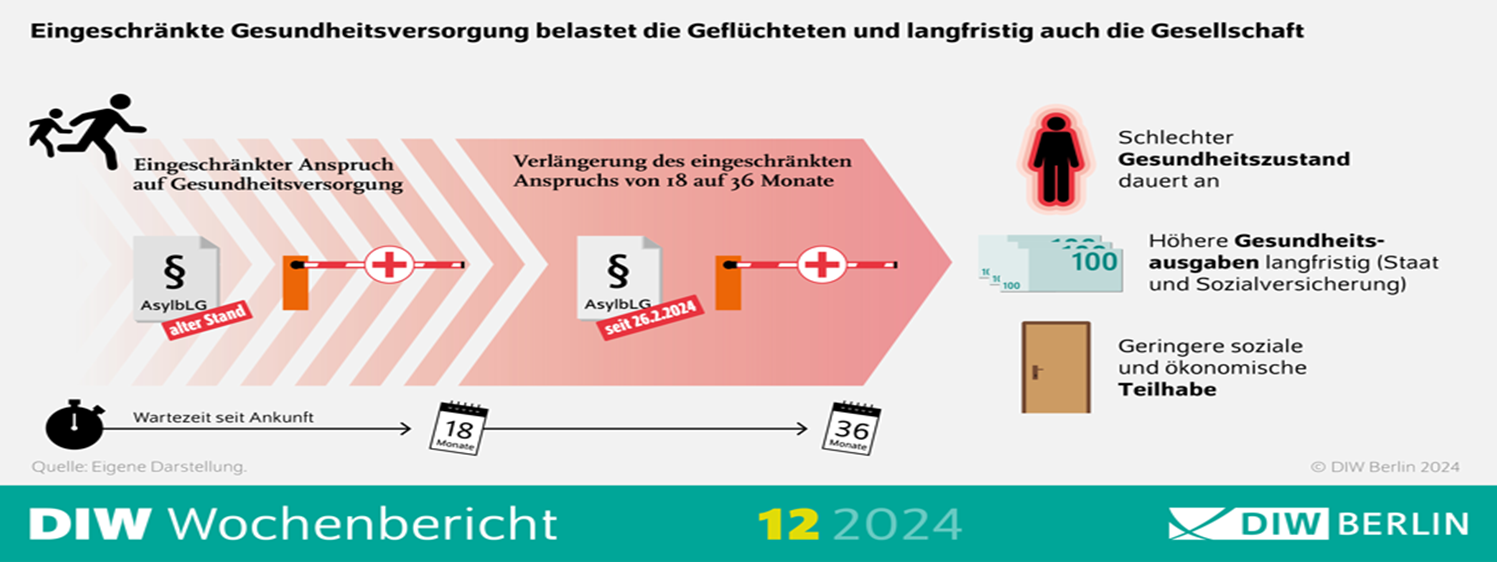
Bölian, C., Trubeta, S. (2026): Electronic health card for asylum seekers – findings from a pilot project in the district of Stendal, Sachsen-Anhalt ed. Hochschule Magdeburg-Stendal and Flüchtlingsrat Sachsen-Anhalt e.V. — Available at http://h2.de/kindheit-und-migration Called on 06.05.2026
medibueros.org (2026) https://medibueros.org/ Called on 06.05.2026
Handbook 6-AsylbLG (2026) https://tacheles-sozialhilfe.de/files/Weisungen/AsylbLG/2022/Handbuch-6-AsylbLG.pdf Called on 06.05.2026
Asylum Info Germany (2026): https://asylum-info-germany.de/de/healthcareforrefugees Called on 06.05.2026
W2EU (2026) https://w2eu.info/en/countries/germany/medical Called on 06.05.2026
Abortion
Basic information on abortion in Germany
Pregnant women have a right to an abortion!
Nevertheless, in Germany, abortions are still regulated in the Penal Code in §218 and §219.The termination can take place without penalty after a confirmation of the pregnancy, if the following conditions are met:
- The 14th week of pregnancy has not yet been reached. (12 weeks after fertilization)
- Performing a pregnancy conflict counseling including obtaining the counseling certificate
- At least 3 days interval between consultation and termination (earliest termination date on the 4th day after consultation)
- Counselling and discontinuation must not be carried out by the same person
- Medical indication or criminological indication
Persons with low or no income can apply for sedentary assistance for termination of pregnancy, regardless of the form of insurance and the income of the partner or parent.
In Germany, there is the possibility of a medical and an operative abortion.
Medication abortion
A safe method up to the 9th week of pregnancy (from the first day of the last menstrual period) in which, after a medical examination, the drug Mifegyne is given the active ingredient Mifepristone, which initiates the termination by blocking the body’s progesterone, and a prostaglandin preparation is then taken one to two days later. This drug causes a menstrual bleeding, which causes the tissue to bleed, the symptoms of which are similar to those of a natural miscarriage, but the bleeding can vary in intensity and length. It is important to see a doctor for a bleeding that is more severe than your own period. 41% of the abortions in 2024 were medical with mifepristone. This includes about 2-3 practical visits in about 14 days.
Surgical abortion
This safe method of abortion is carried out by general anesthesia or local anesthesia, a method of extraction (most common) for about 5 to 10 minutes, by extracting the amniotic sac and mucous membranes from the uterus using a thin tube, and then scraping them out, by removing the amniotic sac and mucous membranes using surgical instruments. This method can also cause bleeding and abdominal pain, which is chosen between the 10th and 14th weeks of pregnancy.
Profamilia (2025). Abortion of pregnancy what you should know – what you have to pay attention to. https://www.profamilia.de/service/publikationen-und-broschueren/detail/schwangerschaftsabbruch-was-sie-wissen-muessen-was-sie-beachten-sollten called:23.04.2026
Profamilia (2026) Abortion methods. https://awo-schwanger.de/schwangerschaftsabbruch/abtreibungsmethoden-abtreibung-ablauf/ Called on 23.04.2026
Access to abortion for displaced people
Criminalisation and the multiple requirements for access to abortion without impunity are an additional challenge for refugees and “illegalised” pregnant women. The stigmatisation of abortion also leads to insufficient access to information, especially for people who have little or no knowledge of the health system and insufficient knowledge of German.
Human Rights Organization Amnesty International reports that abortion laws and access to them have the greatest impact on marginalized groups, writing: “These laws and policies reinforce and perpetuate intersectional forms of discrimination and have a very different impact on people facing multiple, mutually reinforcing forms of discrimination and numerous obstacles to exercising their sexual and reproductive rights.”
A detailed report by the human rights organisation Amnesty International on access to abortion in Europe underlines the position of ROSA:
Already marginalised groups such as low-income people, migrants, refugees and LGBTIQ people are damaging the criminalisation of abortion. Criminalisation is not in accordance with the human rights of those who wish to have an abortion terminated, nor with the providers of such services, nor with the realities of today’s abortion care, which is safe, effective and safe. Human rights institutions have found that criminalisation leads to the provision of health products and services of poor quality, is associated with a lack of registration and unavailability of vital medicines, including mifepristone and misoprostol, hinders the provision of information on abortion, restricts training to perform abortions and is associated with delayed and unsafe abortions. It fails to meet the obvious objectives of protecting people willing to have unsafe abortions or preventing abortions, while health scientists generally associate decriminalisation with a reduction in stigma, improved quality of care and better access to safe abortions.
The additional detours not only cause an additional expenditure of bureaucracy, such as the organization of language mediators. Access to the health system is more difficult.
This also means that pregnant women living in community accommodation can only go to doctors with a treatment certificate. People who have applied for asylum are obliged to live in a reception centre at the beginning and then in a community accommodation. The decision about this treatment certificate is not the responsibility of the person concerned (see text Access to the health system). These factors make it immensely difficult to meet the requirement to terminate a pregnancy in the prescribed time frame in Germany.
Furthermore, the hurdles for pregnant women without a valid residence permit are even greater, as they are often afraid to be reported through contact with various institutions, and even if they do have access, the health system is far from being free of prejudice, stigma, racism and discrimination. Amnesty International is calling for European governments to ensure that abortion and subsequent follow-up care are universally accessible, available, acceptable, affordable and of good quality.
Terminations of pregnancy must be carried out in consent without discrimination or coercion, respecting the rights and needs, dignity, privacy and autonomy of the pregnant person. Specific measures are needed to ensure non-discriminatory access to information and abortion for vulnerable groups, which should be designed with the involvement of experts from marginalised communities and/or reproductive health.
The number of refugees is increasing year on year, and about 25% of refugees are of childbearing age.The study on abortion rights for refugees worldwide examines how refugee status affects refugees’ access to abortion. It analysed refugee movements in 2022 as well as data on the abortion laws of individual countries in order to identify patterns of forced migration and related legislative changes. The study findings point to the need for renewed commitment to ensure refugees have access to the full range of sexual and reproductive health services so that they can exercise their human right to decide if, when and how many children they want to have.
Amnesty International (2025) When rights do not apply to all: The fight for access to abortion in Europe. https://www.amnesty.org/en/documents/eur01/0275/2025/de/ and https://www.amnesty.ch/de/themen/frauenrechte/schwangerschaftsabbruch/europa-recht-auf-schwangerschaftsabbruch-ist-zunehmend-unter-druck?fullobjects=1&include_items=1&expand=translations Called: 23.04.2026
Amnesty International (2025) https://www.amnesty.org/en/documents/eur23/9544/2025/en/ Called: 23.04.2026
Erhardt-Ohren, Prata (2025) Abortion rights for refugees around the world: A scoping review and quantitative analysis of abortion laws and forced displacement in 2022. https://doi.org/10.1101/2025.01.16.25320653 www.medrxiv.org/content/10.1101/2025.01.16.25320653v1.full (accessed: 23.04.2026)
Additional information:
- EIGE Bericht: Women fleeing the war: Access to sexual and reproductive healthcare in the EU under the Temporary Protection Directive; Gender-based violence: https://www.google.com/url?sa=t&source=web&rct=j&opi=89978449&url=https://eige.europa.eu/sites/default/files/documents/Women%2520fleeing%2520the%2520war%2520-%2520Access%2520to%2520sexual%2520and%2520reproductive%2520healthcare%2520in%2520the%2520EU%2520under%2520the%2520Temporary%2520Protection%2520Directive.pdf&ved=2ahUKEwjdh8XGoaqTAxXo9rsIHaxpD1QQFnoECCEQAQ&usg=AOvVaw04hxo94HmEmBvfOyB88nhH Called: 23.04.2026
- Multilingual information: App: Safe Abortion – Hesperian Health Guide
- Further study and publications to identify the additional barriers to accessing safe abortion for migrants: https://internationale-gesundheit.charite.de/en/research/bua_grand_challenges_exploration_project_migration_and_health_migrah/zugang_zu_schwangerschaftsabbruch_bei_migrantischer_bevoelkerung Called: 23.04.2026
- ELSA study (experiences and living conditions unintentionally of the brothers-in-law – offers of advice and care) https://elsa-studie.de/projektpublikationen/ Called: 23.04.2026
- de Londras F, Cleeve A, Rodriguez MI, Farrell A, Furgalska M, Lavelanet A. The impact of criminalisation on abortion-related outcomes: a synthesis of legal and health evidence. BMJ Global Health2022;7:e010409. https://doi.org/10.1136/bmjgh-2022-010409
- Ulrich, H-S et al (2022): Resources, burdens and care requirements of unintentionally pregnant refugees and “illegalized” women: a realist review in healthcare 2022; 84(08/09): 713 Stuttgart DOI: 10.1055/s-0042-1753590
- Alternative Report on the 9th Periodic Report of the Federal Republic of Germany on the United Nations Convention on the Elimination of All Forms of Discrimination against Women (CEDAW) for its 85th Session (08 May 2023 – 26 May 2023) Sexual and reproductive Health and Rights, in particular the right to safe abortion: hier abrufbar https://tbinternet.ohchr.org/_layouts/15/treatybodyexternal/Download.aspx?symbolno=INT%2FCEDAW%2FCSS%2FDEU%2F52681&Lang=en Called: 23.04.2026
- IPPF, Imogen Mathers 2024 Germany’s archaic abortion law creates huge burden for people needing care https://europe.ippf.org/stories/germanys-archaic-abortion-law-creates-huge-burden-people-needing-care Called: 23.04.2026
FGM/C
The abbreviation FGM/C describes female genital mutilation and/or cutting in German “female genital mutilation”.
The term FGM/C is the medical term and summarizes different forms of this procedure. Affected persons can feel victimized by an uncoordinated choice of words. Persons with FGM/C do not feel mutilated in some cases or the individual positioning to their own affectedness is very different.
In this text, FGM/C is used as a medical umbrella term.
The term ‘female genital mutilation’ refers to all interventions in which the external female genitalia is partially or completely removed or the female genital organs are injured for non-medical reasons.
FGM/C as a gender-specific cause of displacement
Worldwide, approximately 230 million women and gender-diverse people are affected. FGM/C is an extreme form of gender-based violence and violates human rights. FGM/C has no medical benefits and is mostly practiced in childhood up to 15 years.
This approach is a form of violence divided into 4 categories, the following four categories are explained in the pictures.
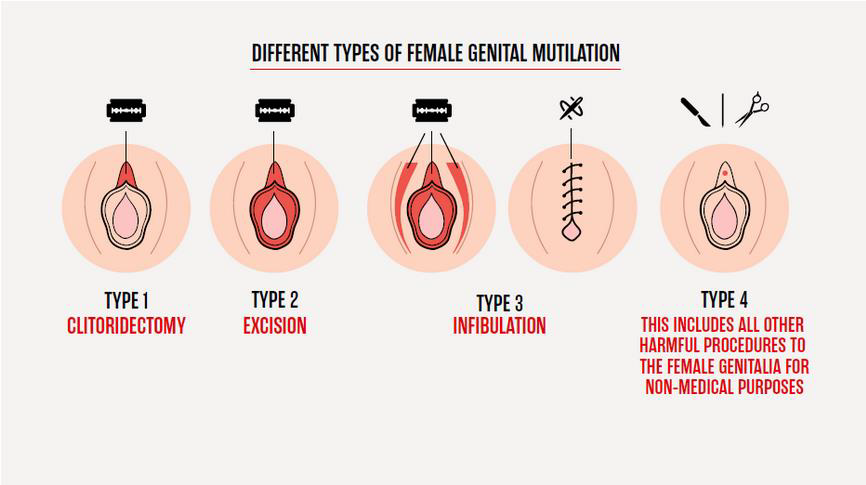
Wen, C., Y., Baity, M. (2023): The Hidden Cut. R-AGE Online available at: https://www.rage.com.my/the-hidden-cut/ (accessed on 01.07.2023).
See link here Types of Fgm/c
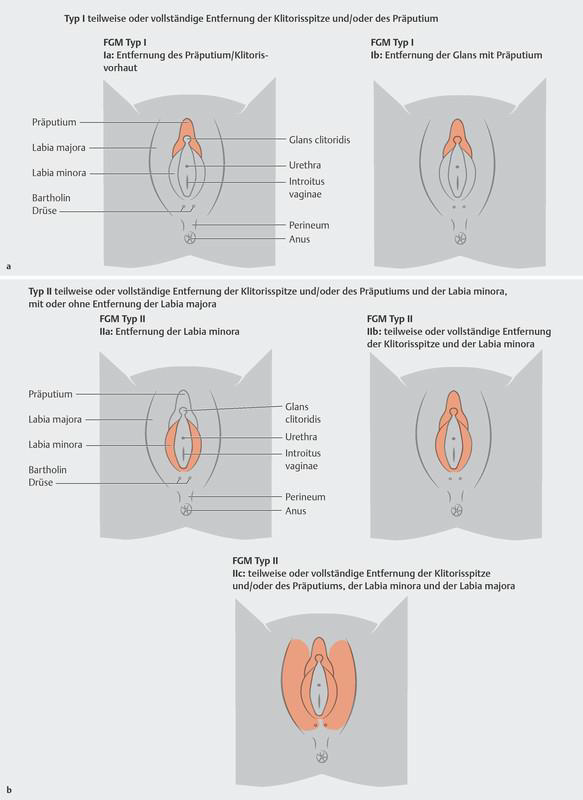
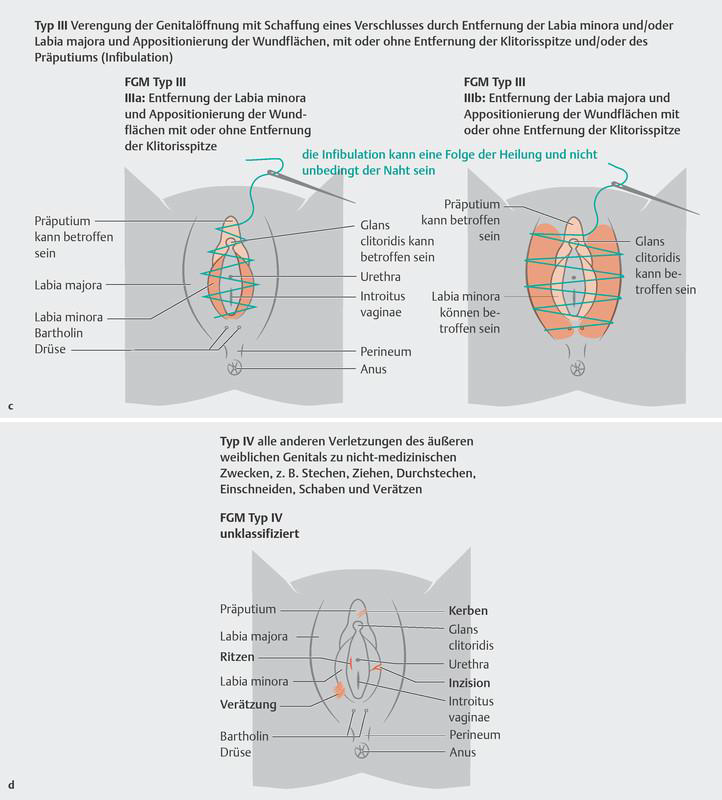
En-Nosse, M., Runge, I., von Saldern, C., Mürdter, E., Schmidt, N.C. (2022): Female Genital Muti-lation in Germany – recognize and treat, Frauenheilkunde up2date 2022; 16 (4): 305–326.
For potential future sufferers, it is difficult to barely realize FGM/C to avoid FGM/C. FGM/C is hardly possible to avoid due to complex structures, among other things due to the age group affected by FGM/C, as well as the fact that FGM/C is carried out in relative circles with a well-intentioned intention – that of a good future.
Health consequences
FGM/C can have multi-layered health and psychological consequences for affected persons and make everyday life (on the run) more difficult. The health effects on affected persons can be divided into short-term health consequences, psychological and psychosomatic consequences, as well as subacute and chronic somatic consequences as follows.
Short-term health consequences:
• Psychic acute trauma, shock caused by fear of death, extreme pain and uncontrollable bleeding, hemorrhagia, anemia.
• Infections (local infection of urinary tract, uterus and ovaries, general infection, septic shock, HIV infection, tetanus, gangrene), general blood poisoning can lead to death
• Problems with urination (urin retention, urethra edema, dysuria)
• Injury to neighboring organs (urehra, bladder, anal sphincter, vagina, bartholinic glands), fractures (femur, clavicle, humerus by holding)
Psychological, psychosomatic consequences
• Severe physical and mental trauma
• Post-traumatic stress disorder, anxiety, depression and dissociative disorders, disorder of eating behavior, chronic irritability
• Feelings and fears are difficult to express, feelings of being incomplete
• Psychosomatic disorders such as non-specific abdominal, head or back pain,
Bracing
• Loss of trust with caregivers, attachment disorders
• Sexual disorders
• Partner* conflicts
Subacute and chronic somatic consequences
Delayed wound healing due to infection, anemia, malnutrition
• Ascending infections (urocystitis, urethritis, vaginitis)
• Sexuality/menstrual disorders (dyspareunia/apareunia, vaginal stenosis, infertility/sterility, dysmenorrhea, menorrhagia, chronic vaginitis, endometritis, adnexitis)
• Vaginismus (divorced convulsion)
• Chronic pain caused by nerve damage
• Problems with urination (recurrent urinary tract infection, prolonged urination),
Incontinence, vaginal crystals
• Complications of scar tissue (abscess formation such as vulvovagina abscesses),
Keloid formation, dermoid cysts, neurinomas, e.g., as amputational neuroma of the clitoral nerve
• Urinary and fecal incontinence (fissels)
Hematocolpos, Pyokolpos
• Permanent hypersensitivity, chronic vulvodynia
FGM/C in Germany
There are currently around 600 000 women and girls affected by FGM/C in the European area. According to the country risk calculation, 190 000 women and girls in the European area are affected by the risk of genital mutilation. Whereas current data collection is made more difficult by a lack of knowledge – skilled workers, such as midwives, are not sufficiently trained; research on FGM/C is inadequate, not least due to a lack of willingness to finance long-term research on FGM/C.
FGM/C in asylum proceedings
FGM/C is one of the gender-specific reasons for persecution (§3a para 1 no. 1 AsylG, i.v. m § 3a para 2 no. 6 AsylG).
FGM/C can therefore be a ground for recognition, especially if girls and women in the country of origin of FGM/C are threatened. German asylum law has only explicitly taken gender-specific causes of flight into account since 2005, including the flight from FGM/C.
EIGE (2021) Estimation of girls at risk of female genital mutilation in the European Union: Den-mark, Spain, Luxembourg and Austria. Vilnius: European Institute for Gender Equality https://eige.europa.eu/sites/default/files/documents/mh0421125enn_002.pdf Called on 06.05.2026
Refugee Council of Lower Saxony e.V., AMBA (2022) Concernedness of FGM/C as a protective ground – What to do if the BAMF requires proof? https://www.frnrw.de/fileadmin/frnrw/media/downloads/Themen_a-Z/Asylverfahren/2022-03-24_factsheet_FGM_C.pdf Called on 06.05.2026
The Parity Comprehensive Association (2026) Gender Epic Persecution and Implementation of Gender-Rights in Asylum Procedure https://www.der-paritaetische.de/alle-meldungen/geschlechtsspezifische-verfolgung-und-
enforcement-of-gender-rights-in-asylum procedure/accessed on 06.05.2026
Additional information
Refugee Council Saxony-Anhalt e.V. (2026) Information on the special protection needs in the asylum procedure https://www.fluechtlingsrat-lsa.de/besondere-schutzbedarfe/ Called on 06.05.2026
WHO (2008) Eliminating female genital mutilation: an interagency statement https://www.who.int/publications/i/item/9789241596442 Called on 06.05.2026